I was recently clearing out some paperwork and found this little list of tips for greener vehicle use. I'm assuming it they came from a seminar of some sort.
Anyway here they are, with my comments in brackets:
Minimise vehicle use
Do multiple errands on one trip
Utilise nearby shops (as opposed to distant ones)
Avoid peak hour wherever possible (so much petrol consumed going at walking pace or standing still - fortunately electric cars are far better in this aspect)
Drive in high gear at about 1500-2500 rpm
Drive smoothly and avoid unnecessary acceleration
Minimise fuel wasted in idling
Speed kills (not just lives but petrol too) - a journey uses 5% more fuel if travelled 110kmh compared to 90km/h
Minimise drag - roof racks, spoilers, open windows can increase fuel consumption by 20%
Inflate tyres - also gives longer life and better handling
Air conditioning uses 10% extra fuel, but if you're travelling faster then 80km/h then it's better than leaving the windows open
Travel light (having the bag of golf clubs permanently in the boot weighs you down)
Service regularly
Hope that help you reduce your fuel bills and your emissions.
Of course, the biggest and maybe simplest thing you can do is (next time you get a new car) choose one with low fuel consumption. The Green Vehicle Guide is the place to go to compare cars available in Australia.
Sometimes elections can seem like a high-waste event. Here are some tips to minimise the environmental impact of the day.
Why the flyers?
The info on the flyers is important in a federal election. The Senate is a crucial part of our democracy and for a Senate vote to be valid we need to number at least 6 parties in our order of preference.
Who are these people?
There are so many parties on the Senate ballot paper. Many have ambiguous or strange names, so it's hard to know exactly who you are voting for, or giving your preferences to.
You can do your own research - the ABC has a Senate Guide. Click your state at the top and you'll get a page with links to all the parties that are running in your state. For example, here is the Queensland list. [Edit: Buzzfeed also have this informative (and humourous) guide.]
But with 25-30 parties running in most states, many people find that too hard and opt to follow their favourite party's how-to-vote card.
What can we do
While the papers are important we can still minimise our impact - and the impact of others. Depending on your enthusiasm, here are several levels of waste reduction you can do.
Level 1
Only take flyers from candidates or parties that you are interested in. I see people take flyers from every party. I guess it seems polite but it's just a waste.
Level 2
Put any flyers you take in the recycle bin supplied at the booth, or at home.
Level 3
Take care of the flyer(s) you take so it's in good condition to return it to the volunteers. They can use it again.
Level 4
After voting, casually take a bunch of used flyers out of the recycle bin at the booth and return them to the volunteers for reuse. The more leftovers they have at the end of the day, the more confident they can be in printing fewer copies next time.
Going online
Parties are starting to put this information online. The Greens one is the most user-friendly. Labor also do it, but it seems to require a fair bit of personal information to be entered.
The Liberal party one is semi-functional. It's hard to tell what parties it suggests to preference. The names of other parties are either removed or too small to read (at least on my screen). I'm hoping this is poor design rather than a deliberate attempt to hide the identity of the party they suggest you give your preferences to.
Again the ABC provides a great resource of all the how-to-vote cards for each state. Here's the Queensland list. For other states click your state at the top of the page. It's handy to see them because each party's suggested preferences give you an idea of what they stand for.
Take heart
The sight of all this paper can be disturbing to the eco-minded. Bear in mind that good parties are now printing on recycled material and most of the paper is recycled afterwards.
Whilst they are very visible, federal elections are only once every three years. The stuff that happens every day of the year (and often out-of-sight) adds up to a far bigger impact than election day. Once the election is over let's get back to fixing those issues.
Try to walk or cycle to the polling booth. It avoids parking problems and positive environmental impact is even greater than what you do regarding flyers.
We've recently switched our electricity provider to Powershop. I'm highly recommending it. Here are 8 reasons why it's a great choice.
Renewable energy makers
Whichever electricity retailer I choose, they're going to make a profit from me. I'd prefer that profit to go to a good company. Powershop is owned by Meridian Energy, which also makes renewable energy. That's the kind of company I like to support.
Greenest electricity provider
The Green Electricity Guide ranks electricity companies on their green credentials. This includes emissions from power stations they own, their policy positions on renewable energy and fossil fuels, their deals for solar consumers, and their promotion of energy efficiency.
Powershop tops the list every year and is one of only two companies with a 5-star rating.
Cheaper Electricity
Electricity costs are made up of two parts - the daily 'supply charge' and the 'usage rate'. Both of these are cheaper than our previous provider. Also, their pay-on-time discount applies to both areas. Other providers generally offer their discount only on the usage charge part of the bill.
You won't see much advertising for Powershop. Instead of paying for TV ads, they just give the money to customers. What a great way to do business!
If you sign up with my special link you'll get $75 credit and so will I.
Top-ups
Powershop also does billing better. You can top-up your credit at any time (like a prepaid phone or a public transport card). You get a discount for doing this. For example you can buy $100 credit for just $85.
Smaller bills
Powershop bills monthly rather than quarterly. (Yay!) Apart from making it easier to budget for, it's also less of a shock because each bill is around one-third what you are used to paying. Powershop also lets you know a few days ahead of time, so you have a chance to double-check you have enough credit to cover the bill.
What about my solar panels?
The Energy Made Easy site doesn't really cater for solar households. You might have to compare the rates to your current bill. Generally their solar rates are good (part of their great environment score). Here's the link to check rates for your area.
What do other customers think?
Powershop is big in Victoria (their first state). Amongst its customers there it rates 5-stars in most categories and out-rates the major retailers by quite a margin.
Are there any negatives?
I know of only two possible negatives. The greenpower option is slightly more expensive (at least compared to my previous provider). However, as 100% Greenpower customers we found this small extra cost was offset by Powershop's great base prices. Even with our 100% Greenpower the overall cost was practically identical. The sign-on bonus was waaay more than the tiny difference in cost. We changed mostly to support a renewable energy company with better business practice. If you're not a purchaser of Greenpower, then you should have lower cost, and a sign-on bonus.
The only other thing is that your very first bill may be based on estimated usage. Powershop bills monthly, but physical readings are only done quarterly. So your first bill may seem bit low or high. This will even out once they've done a physical reading. Or you can choose to enter your own DIY meter readings via the website.
In summary
If you're looking for the cheapest deal, Powershop's a great choice.
If you're looking for the greenest electricity company, Powershop's a great choice.
If you'd like more for the solar power you export, Powershop's a great choice.
If you'd like to receive a sign-on bonus, Powershop's a great choice.
An obvious everyday action we can take is to recycle - and to buy products made from recycled material. A great example is the company Who Gives A Crap.
This company makes recycled toilet paper, gives free delivery (in metro Australia) and gives 50% of profits to build toilets in developing countries where people are literally dying from diarrhea etc as a result of poor sanitation.
If you haven't yet bought from Who Gives A Crap, here's a special $10-off offer (for a limited time).
It has no inks, dyes or scents and the packaging is zero-plastic; all cardboard and paper (easy to recycle). The rolls are also double-length rolls so you get a lot more use between roll changes.
Note that this is a special offer for new customers. Existing customers, you already know how good this is - you don't need extra enticement.
PS. In full disclosure, I also get $10 off my next purchase if you take up this offer. So it's a win for everyone - you, me, the environment and African kiddies. :)
This weekend phone books arrived on our doorstep. Nearly 800 pages of info we'll never use nor need. Thumbs down for pointless waste.
To add a little more pain they wrapped all the books for our apartment building in shrink wrap. Aaagh!
You can avoid this happening to you, and eliminate waste at the same time. Go to Directory Select.
Enter your street address to see the phone books you are currently set to receive. Highlight the ones you wish to cancel, tick the box and click to cancel. It's really as easy as that.
PS. I was amused that the cover shot shows that computers exist (and that therefore phone books don't need to). It could only be be more ironic if the screen showed the Google homepage. ;)
What to do with old clothes? Some are technically wearable - but waay out of fashion, or getting a bit old. Some are beyond wearing. What can I do that isn't adding to landfill?
Now there's a recycle option. One that comes with rewards.
Drop-off at H&M stores
Fashion store H&M has a zero waste goal for the clothes (and other textiles) that you drop off in their recycle stations. So far they've taken in the equivalent of 89 million T-shirts for their Rewear, Reuse, Recycle process.
Rewear
Clothing that can be reworn is sent overseas for second-hand use.
Reuse
Textiles no longer suitable to wear are converted into product such as cleaning cloths.
Recycle
Textiles that can't be reused are recycled into textile fibres or used to manufacture products such as insulation materials.
Reward
For each bag of used textiles they'll give you a discount voucher. Mine was 15% off your next item. It may vary for different places or countries. If you don't need it, why not pass it on. It's a chance to brighten the day of a random shopper.
What to do
Up the back of the shop, look for a recycle station like this one.
Queensland's Container refund scheme starts 1 November. It's great for the planet, for people and for community groups. Here's why.
Quick stats
3 billion containers are used in Queensland each year. They make up 23% of our waste. Even with kerbside recycling, the majority end up as litter or in landfill.
We recycle only about 30% of our containers. In South Australia (who've had a container deposit scheme for years) the rate is 80%.
Clearly a cash-for-containers scheme is a good idea. Queensland's will be called Containers for Change.
What's the deal?
From 1 November there will be 250 refund points (see the map) where you can receive 10 cents for every eligible container - including aluminium cans, glass bottles, plastic bottles and some drink cartons.
Reverse vending machines
Some refund points will be reverse vending machines - like the demo one I showed earlier (see the video). These are literally what they sound like - you give a container and get money. Each container has its barcode scanned. If the barcode matches an eligible container you get paid.
Depots and drop off points
There will also be places you can take containers to and drop them off. The advantage of these (other than not having to feeding all your containers into a machine) is that even if the aluminium cans are squashed, and the barcode isn't readable, they are still accepted.
How does it work for community groups?
After litter reduction and more recycling, the third aim of the scheme is to help community groups. People can donate their containers to the local sports club, scouts, church or school - and that organisation can receive the refund.
This can be done by physically donating the container or by a virtual donation. Either way, the first step for a community group is to register and get an ID number (this is how you get paid).
Virtual donations
Publicise your ID number through your community group. When your members return their containers they can quote the community group's ID number and the refund is paid to the community group's bank account.
Physical donations
In this case people donate the actual containers at your scout hall, soccer club or church hall. Somebody from the group can return them in bulk to a refund point. Again, they quote the community group's ID number and the refund goes to the group's bank account.
At my local school they've got small wheelie-bins bins ready to go. (You can get the logos and everything when you join).
The logistics of this depend on how big your operation will be. Many refund points will be able to give you a large bag for collecting your containers, and a tag with your group's ID. If you're thinking bigger than that you may want to get a lockable cage where people can drop off containers any time of the day.
If your group is having a big event, it may be a good idea to contact your local refund point in advance and they may be able to help.
So what are the next steps?
Once you community group decides to do this, go online and register and promote you group's ID to your members.
Then, if you want to do physical collection, get in touch with you local refund point.
Any questions, just pop them in the comments below.
Happy recycling and happy fundraising.
PS. This information is based on the seminar by ContainerExchange - the organisation running the scheme. For further details go to Containers for Change or to ContainerExchange.
Today is the start of the "eco coffee cups" deal at Toowong Village.
So what's the deal?
Spend $10 at the shopping centre to get a free re-usable coffee cup - and a bonus free coffee. There's a limit of one 1 per person per day, so if you want a cup for every person in your office, that will take a while.
Is there a catch?
Not really - except for the choice of designs (but you may like them). Collection times are 9am-6pm while stocks last. Just take your receipt (on the same day) to the info desk on the basement level for your free cup.
Is it really free if I have to make a $10 purchase?
Good point. Making a needless purchase in the name of being "eco" would be odd. However the deal covers all stores including groceries (albeit Coles), the fruit shop and a bakery. So if you'd buy those kind of products anyway, why not get a free reusable cup?
How bad are disposable cups?
Toowong Village say that the coffee cups used by Australians in a year could stretch around the globe 2.5 times.
For further info see the centre's announcement. It's good to see the centre doing something - even if some of its coffee shops haven't yet joined Responsible Cafes. Perhaps we should ask each store if they have (or will) join and offer a discount for customer with a reusable cup.
You may have heard of Dresden. It's an Aussie optometrist/glasses company that makes frames from recycled plastic waste.
Their new range of frames are literally made of money. Offcuts and misprints from Australia's plastic banknotes make been chopped up and melted down to make this limited edition collection of frames.
It's so amazing what can be recycled when we put our mind to it.
For Brisbane readers
I'm told there will be a store in West End by November. Of course you can also buy online before then.
On a personal note
I'm quite excited by Dresden coming to Brisbane:
1. Sometimes I feel that my impact is small. When a company does something great - like using recycled materials - that is huge. With our support, they can grow and increase their positive impact.
2. I'm starting to need glasses for reading. Though I like the idea of buying online, as a first-timer I'm keen to buy in-store to see what suits and fits me.
Subscribe for updates
I'll be posting when Dresden open their store - and I get my first glasses. Subscribe below to get new blog posts by email.
PS. Yes I was wearing some basic magnifiers (borrowed) in my previous post. They're keeping me going until Dresden opens here.
UPDATE: The official opening of the Brisbane store is Tuesday 6 November at 4/173 Boundary St, West End.
The Biome collection is part of the Terracycle program. You can start your own collection at your local school or community group (and raise money for that group). It's convenient for you and can help other people in your group get involved in recycling.
Farmers have hit the headlines here in Australia as large portions of Eastern Australia are in drought.
Very little rain means farmers are running out of water and often running out of feed for their animals. Obviously Australians want to help. But what to do?
This stat from The New Joneses (about the environmental impact of food) gave me an idea:
If we're choosing to eat meat, how about we switch some of our red-meat for chicken or pork? These meats require 11 times less water to produce, so farmers would need far less water to produce the same amount of meat.
It seems like the smart option in a country that is getting more and more droughts as climate change increases. The only thing it needs is for us customers to be buying it instead of red meat.
Obviously it's long-term solution but, given the inadequate government action on climate change, these droughts are also going to be a long-term part of our future.
The side bonus is that (according to the original science article) these meats also produce 5 times less greenhouse emissions - so our contribution to climate change (and future droughts) will be decreased.
Canadian couple Grant and Jen wonder whether it's possible to live waste-free. What about going a year without buying anything (other than food)?
Their solution
A head-to-head competition where less is more. One bin each. Who will have the least waste?
Here's the trailer:
There's fun is watching how they navigate the challenge - and learn how to quickly add "no bag" every time they buy food.
Their 3 Rules
1. No buying stuff (no devices, no clothes, no shoes, no material presents)
2. No producing garbage.
3. Take responsibility for their own waste (even if eating out).
They also meet some interesting people along the way:
Brian
Brian Burke lives in a block of 20 units which no longer needs a garbage bin. They have some containers in the garage for collating things like batteries, bottle tops etc that they take to specific recycle places.
Brian's favourite thing is compost - it eliminates so much waste.
Chris
Chris Jordan is the corporate lawyer-turned-artist who creates some mind-boggling art out of showing just how much waste we generate. It's one thing to know that America uses 210 billion cups. But to see that number represented in art really hits home.
Check out his website, particularly the galleries Running the Numbers and Running the Numbers 2. These artworks are normally several metres across. From a distance they look like a normal picture (or nothing at all). It's only when you step up close (or zoom in on the website) that you can see what makes up the picture.
What to do?
If you're keen to see the movie, you can rent it online - or buy the DVD (in very minimal packaging).
If you're keen to get started, check out the Top 10 Tips from the couple who spent a year doing this.
For people in apartments, also check out ShareWaste for composting.
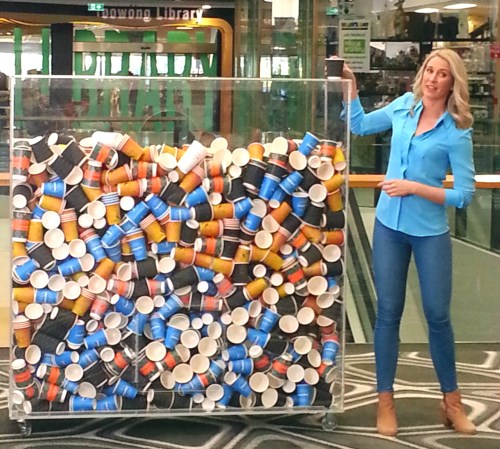
Why the huge display of disposable cups? Why film this?
Scene: A presenter crosses in front of a giant perspex container of disposable cups. She delivers yet another variation of a single line-to-camera.
"Used once" [holds up cup] "then in landfill forever" [looks at cups].
So what's going on?
My "investigative journalism" reveals that the shopping centre will soon have a "campaign" to reduce coffee cup waste.
Here's the deal
From late August, spend $10 in Toowong Village shopping centre (even just groceries) and you can get a free reusable cup.
Disclaimer: This not yet confirmed by the centre. It's just what I've managed to find out. The start date (and duration) are still a mystery but I will let you know when I do.
60% of our bin contents is organic waste - according to War on Waste. Some of that is garden waste. About 31% is food waste says my local council.
One massive thing we can do to reduce food waste is to compost our food scraps.
But we don't all have compost
Many of us live in apartments, or just aren't into composting and gardening. We need another option.
That's where ShareWaste comes in. If you've got food scraps you can find a compost person in your neighbourhood. If you do compost you can put yourself on the map to get extra organic waste from local people. What a great idea!
The first in your suburb?
If there isn't anyone close to you on the map, still sign up. This is quite new - and still growing.
You can register to be alerted when there is someone new near you. Also, you can share this post so that more people find out about it.
Food recycling?
This is an unusual but effective form of recycling. The nutrients in our food scraps can help fertilise more food to be grown. Or maybe flowers. Either way, at least it's not being wasted.
According to War on Waste, the average family generates 73kg of e-waste per year. For a family of five this can be 140kg. Over a decade that's 1.4 tonnes.
As the father of the family remarked, it's quite a lot when you look at it all at once.
Obviously e-waste is big issue. for recycling options near you, see the very well-named website Recycling Near You.
Also see how much you know about e-waste, with ABC's e-waste quiz. The average person gets about 6/10.
(Hint: I gave away one of the answers yesterday)
Australia has a good recycling system for mobile phones. But not many people know about it. Only about 10% of phones are getting recycled.
Why is it important?
As a nation we have 25 million old phones lying around the house.
How much is that?
Craig Reucassel from War on Waste covered this car (and filled the hatch) with mobile phones. He fit in 1,500 phones. To carry all of Australia's old and broken phones, he would need 17,000 cars like this.
That's a lot of waste if they get thrown in the bin. Even the little bit of gold in each broken phone would add up to tens of millions of dollars being thrown away.
So how do we recycle them?
The program is Mobile Muster. You can drop in the old or broken phone to a phone retailer. If you prefer to go direct, you can get a free mail satchel at Australia Post outlets or print the online label and post it yourself.
Mobile Muster also have more information about the recycling process and what it accepted. It includes chargers, batteries and even smart watches.
See how much phone waste you can recycle from your place.
Also, if you missed War on Waste, see the full episode on iView.
Right now Australians recycle just 3% of our used batteries. Where can we recycle them? Many people don't know.
For Australian readers, you can take household batteries (AAA, AA, C, D and 9V) to any Aldi store. See my earlier post for more information.
Battery World take dead batteries of any kind. They can also give you one of these mini-bins, which are handy for collecting used batteries at home or in the office.
Now that we know where we to take them, hopefully the rate of recycling can increase. According to this week's War on Waste, Switzerland recycles 72% of its batteries. So we definitely have room for improvement.
PS. Now my local library is also collecting used batteries. Does yours? I'd be interested to know how widespread that is.
A bottle of water a day costs a thousand dollars a year. So why do people do it?
Is it healthier?
Craig Reucassel (War on Waste) took several bottled water brands - and tap water - to the lab. No brand is really any better than tap water, and many are far worse for you.
Does it taste better?
Craig took to the streets to give people a taste test of tap-water (pretending it was bottled water) and people actually said they would switch to that "brand".
Perhaps it's all just a marketing con
The bottled water use nature-sounding words and lots of marketing. Perhaps that's why we buy it. To illustrate the point Craig made this satirical ad for Robinet Water:
Is it more convenient?
It makes it getting it easier. But without a nearby recycle bin it also makes waste easier - and that's not good. It also costs $1000 for that convenience.
Surely given the choice of having your own refillable water bottle or paying $1000 every year, the refillable bottle has to be the winner.
Reusable bags are great. Even better if they're unique. Here's one way to MacGyver yourself a unique reusable bag - and hold on to a fave T-shirt for a little bit longer.
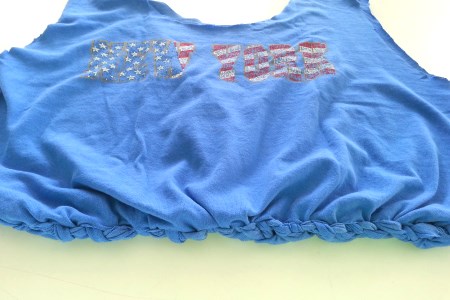
Grab an old T-shirt that you like, but has been retired from public wearing. After 10 years, my New York one is a great example.
Take out the arms and the neck area. For speed, just cut along the inside of the seams. Or you can use a plate to trace a nice round curve. Up to you. You can always cut more off later, if you want to adjust the shape.
Now let's seal up the bottom. Turn it inside out. Decide how deep you want your bag to be and draw a marker line there. Cut slits up to that line. I did them about 1.5 - 2 cm apart, but it's up to you.
Tie each pair of strips together. Now you have a bunch of knots across the bottom with tiny holes in-between.
To strengthen the bag, and seal up those small holes, tie together a strand from knot 1 and a strand from knot 2. Keep going for knots 2 and 3, knots 3 and 4 etc. Now you've got a completed bag - but with a large fringe.
Cut off the excess strands and turn the bag back to the right way out. The bottom should look something like this.
Now you're ready to go. Mine turned out a little smaller than I thought - I cut the slits quite long. But this size is great for picking up a couple of things from the shops, and those other times you just need to carry a few items.
So there you go. That's how you can turn a T-shirt into a reusable bag with just a pair of scissors and a marker pen.
PS. If you like the fringe at the bottom - or you're making something for Country & Western Week - then ignore the bit about turning it inside out before cutting the slits, and just stop once you've tied all the knots.
Bank Australia is helping out Queenslanders with free calico bags, ahead of the state phasing out single-use plastic bags from this weekend.
At long last the state government is making shops be responsible and stop giving out single-use plastic bags. Shops will still be able to sell re-usable bags.
So to help people make this positive change, the bank is giving away these free calico bags. You don't even have to be a customer, though I do recommend being one - they have such great interest rates, and ethics.