Tuesday, October 30, 2018

Containers for Change - everything you need to know

Queensland's Container refund scheme starts 1 November. It's great for the planet, for people and for community groups. Here's why.

Quick stats

3 billion containers are used in Queensland each year. They make up 23% of our waste. Even with kerbside recycling, the majority end up as litter or in landfill.

We recycle only about 30% of our containers. In South Australia (who've had a container deposit scheme for years) the rate is 80%.

Clearly a cash-for-containers scheme is a good idea. Queensland's will be called Containers for Change.


What's the deal?

From 1 November there will be 250 refund points (see the map) where you can receive 10 cents for every eligible container - including aluminium cans, glass bottles, plastic bottles and some drink cartons.


Reverse vending machines

Some refund points will be reverse vending machines - like the demo one I showed earlier (see the video). These are literally what they sound like - you give a container and get money. Each container has its barcode scanned. If the barcode matches an eligible container you get paid.

Depots and drop off points

There will also be places you can take containers to and drop them off. The advantage of these (other than not having to feeding all your containers into a machine) is that even if the aluminium cans are squashed, and the barcode isn't readable, they are still accepted.

How does it work for community groups?

After litter reduction and more recycling, the third aim of the scheme is to help community groups. People can donate their containers to the local sports club, scouts, church or school - and that organisation can receive the refund.

This can be done by physically donating the container or by a virtual donation. Either way, the first step for a community group is to register and get an ID number (this is how you get paid).

Virtual donations

Publicise your ID number through your community group. When your members return their containers they can quote the community group's ID number and the refund is paid to the community group's bank account.

Physical donations

In this case people donate the actual containers at your scout hall, soccer club or church hall. Somebody from the group can return them in bulk to a refund point. Again, they quote the community group's ID number and the refund goes to the group's bank account.

At my local school they've got small wheelie-bins bins ready to go. (You can get the logos and everything when you join).


The logistics of this depend on how big your operation will be. Many refund points will be able to give you a large bag for collecting your containers, and a tag with your group's ID. If you're thinking bigger than that you may want to get a lockable cage where people can drop off containers any time of the day.

If your group is having a big event, it may be a good idea to contact your local refund point in advance and they may be able to help.

So what are the next steps?

Once you community group decides to do this, go online and register and promote you group's ID to your members.

Then, if you want to do physical collection, get in touch with you local refund point.

Any questions, just pop them in the comments below.

Happy recycling and happy fundraising.

PS. This information is based on the seminar by ContainerExchange - the organisation running the scheme. For further details go to Containers for Change or to ContainerExchange.

Monday, October 22, 2018

Do bad governments hide bad news?

If there's anything worse than a government failing to cut pollution, it's a government covering up the failure.

how the Australian governmnet hides emissions data

People in the media have noticed a pattern in the way Australia's government releases the national emissions data.

It's very slow and it seems to be released at a time when it will get little attention. Mostly it's late on a Friday afternoon - too late for the news bulletin. Or just before the biggest sports weekend of the year.

One year they even did it on Christmas Eve.

Why is it so?

Paul Barry reckons it's deliberate. To avoid the government getting awkward questions about why emissions increasing when urgent reductions are needed. Questions like how on Earth Australia can even reach our (rather weak) goal of 26% less pollution by 2030 while pollution is rising.

The government says that ministers "considers briefs for a period of time". But for those periods of time to always end late friday - or on Christmas Eve is a staggering coincidence.

Or maybe not.

Tuesday, October 09, 2018

What Aussies think about climate change

This year's Climate of the Nation survey (a great name for people's opinions around climate change) has some very interesting - and some surprising results.

Lots of concern

When asked if they we concerned about climate change and its impact of drought, the Great Barrier Reef and bushfires around three-quarters said yes.

ARe Australians concerned about climate change and its impacts

Fewer deniers

At the other end of the scale there's a shrinking number of people do don't even agree the climate change is happening. The vast majority of Aussies accept that it is happening. The results are shown by which party the people vote for.

How many Aussies still don't accept climate science

Even for parties that have non-scientific views, their supporters seem to be accepting the climate science.

Favourite power

People were asked their 3 favourite energy sources. The top 3 were all renewable resources and solar was the clear favourite.

What are Austrlia's favourite energy sources

What to do about coal?

49% say we should stop building any new coal mines or expanding any existing ones. Only 20% disagree with this view.

How quickly should coal go?

About two-thirds of Aussies think we should stop using coal with 20 years. More than a third reckon it should be within 10 years.

How quickly should we stop using coal?

Coal industry less important than we think

Aussies were asked how many people coal employs. Those who answered overestimated by a factor of more than 25. The jobs in coal are 25 times smaller than we think.

The same goes for money. When asked how much coal contributes to Australia's GDP, people's average estimate was 10.9%. It's not even a tenth of that. The true answer is just one percent.

While the coal industry makes some noise, the reality is that it's just not worth as much as we may think.

Who should pay the bill?

59% of people support a levy on fossil fuel exports to help the community prepare and protect from the consequences of climate change. Only 19%
oppose this idea.

Perhaps unsurprisingly, this idea is even more popular among younger people - those expected to have to live with the consequences for longer.

Overall it's good news that Australians want to take action on climate change. Hopefully politicians can reflect this desire in their actions.

PS. You can download the full Climate of the Nation 2018.

Wednesday, September 19, 2018

How companies pretend to be greener

A lot of greenhouse emissions come from companies. Often they state their emissions in the annual report. But sometimes they're a bit tricky about it.

What's the trick?

It's a little thing called emissions intensity. Intensity is a company's carbon footprint divided by how much business it does.

Why is it used?

It's a handy way to compare different-sized companies in a similar industry. A larger company may pollute more but (for its size) be cleaner than its competitors in terms of pollution per customer, or per item made.

How can it be mis-used?

A company with a range of products may report emissions per dollar of revenue.

For example, a T-shirt that causes 20kg of emissions and costs $20 has an emissions intensity of 1 kg/$.


If the price goes to $25, the emissions intensity becomes 0.8 kg/$ - an apparent 20% reduction even though nothing has changed except the price.

It's very tempting for companies to use this figure in annual reports.

24% or just 4%

Telstra this year reported a 24% decrease in carbon intensity - measured per petabyte of data transmitted (a petabyte is a million gigabytes).

I wasn't fooled. It sounded good, but I wanted more info. Their total emissions are down - but by just 3.9%. Not bad. But nowhere near 24%.

So while the total greenhouse emissions are only slightly decreasing (the green bars in the graph) the carbon intensity (the numbers in the circles) give a far rosier picture.


Does this seem like a scam to you?

In this graph alone, data (green line) almost tripled. "Intensity" can trick shareholders and customers us into thinking we're making huge progress - while we continue to pollute as much as before (sometimes even increasing our pollution).

Personally I think yearly emissions should be reported as tonnes of carbon pollution. Intensity should only be used to compare with other companies in the industry.

Are you a shareholder?

If you're going to an AGM, why not ask a question about your company's emissions?

I raised the question at a recent Telstra shareholder meeting - asking about actual emissions rather that intensity. the representative couldn't even tell me whether emissions had gone up or down in the past year. We need to get this on their radar.

PS. I also asked another question. Subscribe to be notified when I write about that.

Tuesday, September 11, 2018

Free reusable coffee cups

Today is the start of the "eco coffee cups" deal at Toowong Village.


So what's the deal?

Spend $10 at the shopping centre to get a free re-usable coffee cup - and a bonus free coffee. There's a limit of one 1 per person per day, so if you want a cup for every person in your office, that will take a while.

Is there a catch?

Not really - except for the choice of designs (but you may like them). Collection times are 9am-6pm while stocks last. Just take your receipt (on the same day) to the info desk on the basement level for your free cup.

Is it really free if I have to make a $10 purchase?

Good point. Making a needless purchase in the name of being "eco" would be odd. However the deal covers all stores including groceries (albeit Coles), the fruit shop and a bakery. So if you'd buy those kind of products anyway, why not get a free reusable cup?

How bad are disposable cups?

Toowong Village say that the coffee cups used by Australians in a year could stretch around the globe 2.5 times.

For further info see the centre's announcement. It's good to see the centre doing something - even if some of its coffee shops haven't yet joined Responsible Cafes. Perhaps we should ask each store if they have (or will) join and offer a discount for customer with a reusable cup.

Related post: What's going on at the local shops?

PS. This deal is now over as all the coffee cups have been claimed. Let me know if you hear of other centres taking an eco-friendly initiative.

Wednesday, September 05, 2018

Coffee cups - a university solution

Recently I let you know how Simply Cups can help you get coffee cup recycling happening at your workplace.

Normally a workplace might get a single collection tube. Larger places, like the Queensland University of Technology, have a dedicated coffee cup recycle bin.

Simply Cups coffee cup collection and recycling bin at QUT

The central tube is designed for any excess drink left in the cup. Then the cup itself (no lid) goes in any of the six outside tubes, automatically stacking inside the previous cup.

Simply Cups coffe cup recycling collectino bin - how it works

The whole bin is about 70-80cm tall, so I reckon it could hold a few hundred coffee cups when they are stacked.

Since I took this photo, QUT moved the cup bin next to another recycle bin, to make it easier for people to recycle the plastic lids in the normal recycling. That helps make sure this bin has purely cups and also helps fit it as many cups as possible.

Tuesday, September 04, 2018

They're literally made of money

You may have heard of Dresden. It's an Aussie optometrist/glasses company that makes frames from recycled plastic waste.

Their new range of frames are literally made of money. Offcuts and misprints from Australia's plastic banknotes make been chopped up and melted down to make this limited edition collection of frames.


It's so amazing what can be recycled when we put our mind to it.

For Brisbane readers

I'm told there will be a store in West End by November. Of course you can also buy online before then.

On a personal note

I'm quite excited by Dresden coming to Brisbane:

1. Sometimes I feel that my impact is small. When a company does something great - like using recycled materials - that is huge. With our support, they can grow and increase their positive impact.

2. I'm starting to need glasses for reading. Though I like the idea of buying online, as a first-timer I'm keen to buy in-store to see what suits and fits me.

Subscribe for updates

I'll be posting when Dresden open their store - and I get my first glasses. Subscribe below to get new blog posts by email.

PS. Yes I was wearing some basic magnifiers (borrowed) in my previous post. They're keeping me going until Dresden opens here.

UPDATE: The official opening of the Brisbane store is Tuesday 6 November at 4/173 Boundary St, West End.

Friday, August 31, 2018

How to recycle a toothbrush

Somethings are hard to recycle - like toothbrushes and toothpaste tubes. But now there's a way.

Biome stores have these collection boxes in store.

Toothbrush and toothpaste tube recycling at Biome stores

So what can we recycle?

Through this program we can recycle toothbrushes, toothpaste tubes, floss containers and packaging.

Acceptable items for toothbrush recycling

What if you're not near a store?

At the moment all Biome stores are in Brisbane.

If you're elsewhere in Australia, why not start your own collection or find an existing one near you.

The Biome collection is part of the Terracycle program. You can start your own collection at your local school or community group (and raise money for that group). It's convenient for you and can help other people in your group get involved in recycling.

Find out more at Terracycle.

PS. US readers, Terracycle US also has a dental products program.

Wednesday, August 29, 2018

The best way to help farmers?

Farmers have hit the headlines here in Australia as large portions of Eastern Australia are in drought.

Very little rain means farmers are running out of water and often running out of feed for their animals. Obviously Australians want to help. But what to do?

This stat from The New Joneses (about the environmental impact of food) gave me an idea:


If we're choosing to eat meat, how about we switch some of our red-meat for chicken or pork? These meats require 11 times less water to produce, so farmers would need far less water to produce the same amount of meat.

It seems like the smart option in a country that is getting more and more droughts as climate change increases. The only thing it needs is for us customers to be buying it instead of red meat.

Obviously it's long-term solution but, given the inadequate government action on climate change, these droughts are also going to be a long-term part of our future.

The side bonus is that (according to the original science article) these meats also produce 5 times less greenhouse emissions - so our contribution to climate change (and future droughts) will be decreased.

Sunday, August 26, 2018

Canberra contacts

There's a lot we can do to make our environment better. Some of the biggest actions can be taken by our politicians - if we the voters encourage them to do so.

Here are the contact details to help you do that:

Prime Minister

Scott Morrison - phone numbers
Contact form
Facebook
Twitter

Environment Minister

Melissa Price - phone numbers
Melissa.Price.MP@aph.gov.au
Facebook
Twitter

Energy Minister

Angus Taylor - phone numbers
Contact form
Facebook
Twitter

Your Local Member

Enter your suburb name to find out your electorate.
That page will also give you the name of your local member.
Google them or find their page on the parliament list.

Tuesday, August 21, 2018

Clean Bin Project (the movie)

Canadian couple Grant and Jen wonder whether it's possible to live waste-free. What about going a year without buying anything (other than food)?

Their solution

A head-to-head competition where less is more. One bin each. Who will have the least waste?

Here's the trailer:


There's fun is watching how they navigate the challenge - and learn how to quickly add "no bag" every time they buy food.

Their 3 Rules


1. No buying stuff (no devices, no clothes, no shoes, no material presents)
2. No producing garbage.
3. Take responsibility for their own waste (even if eating out).

They also meet some interesting people along the way:

Brian

Brian Burke lives in a block of 20 units which no longer needs a garbage bin. They have some containers in the garage for collating things like batteries, bottle tops etc that they take to specific recycle places.
Brian's favourite thing is compost - it eliminates so much waste.

Chris

Chris Jordan is the corporate lawyer-turned-artist who creates some mind-boggling art out of showing just how much waste we generate. It's one thing to know that America uses 210 billion cups. But to see that number represented in art really hits home.

Check out his website, particularly the galleries Running the Numbers and Running the Numbers 2. These artworks are normally several metres across. From a distance they look like a normal picture (or nothing at all). It's only when you step up close (or zoom in on the website) that you can see what makes up the picture.

What to do?

If you're keen to see the movie, you can rent it online - or buy the DVD (in very minimal packaging).
If you're keen to get started, check out the Top 10 Tips from the couple who spent a year doing this.
For people in apartments, also check out ShareWaste for composting.

Monday, August 20, 2018

DIY Recycling with Precious Plastics

Have you heard of Precious Plastics? It's a movement of recycling enthusiasts and designers who shred, melt and mould used plastic into new items.


Today I met some of the people from the Precious Plastics Brisbane group at UQ's Sustainability Week. Their big piece of local news is that the State Library is soon going to have a set of equipment. I'm looking forward to trying that out.

So how does it work?

This week they are collecting lids from plastic bottles, like milk bottle lids for example. They hope to fill this jar many times over.


About 80-90 lids, when shredded up, fill a jar about this size:

jar of shredded plastic - polyethylene

Then those can be melted and injected into a mould (like below left) to make a new item. In this case a small multi-coloured cup / pen-holder. But it can be anything.

injection mould and the final product

If you're in Brisbane, you may be interested in joining the Facebook group.

Wherever you live you can join the community (and see more videos) via the Precious Plastics website.

Friday, August 17, 2018

What's going on at the local shops?

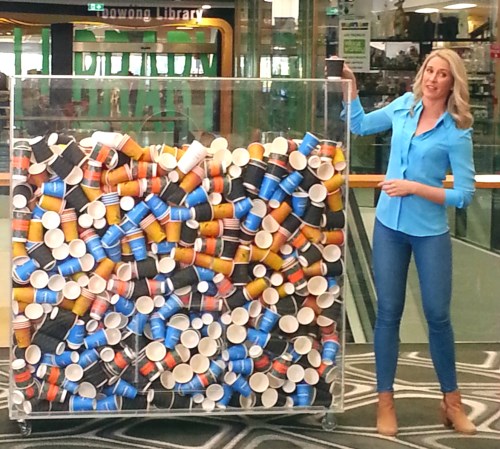
Why the huge display of disposable cups? Why film this?


Scene: A presenter crosses in front of a giant perspex container of disposable cups. She delivers yet another variation of a single line-to-camera.

"Used once" [holds up cup] "then in landfill forever" [looks at cups].

So what's going on?


My "investigative journalism" reveals that the shopping centre will soon have a "campaign" to reduce coffee cup waste.

Here's the deal

From late August, spend $10 in Toowong Village shopping centre (even just groceries) and you can get a free reusable cup.

Disclaimer: This not yet confirmed by the centre. It's just what I've managed to find out. The start date (and duration) are still a mystery but I will let you know when I do.

Update: The deal is now on. Get the details.

Wednesday, August 08, 2018

Cut food waste. Give scraps to a neighbour.

60% of our bin contents is organic waste - according to War on Waste. Some of that is garden waste. About 31% is food waste says my local council.

One massive thing we can do to reduce food waste is to compost our food scraps.

But we don't all have compost

Many of us live in apartments, or just aren't into composting and gardening. We need another option.

That's where ShareWaste comes in. If you've got food scraps you can find a compost person in your neighbourhood. If you do compost you can put yourself on the map to get extra organic waste from local people. What a great idea!

Screenshot of the Share Waste website where you can connect with neighbours to compost your food waste

The first in your suburb?

If there isn't anyone close to you on the map, still sign up. This is quite new - and still growing.

You can register to be alerted when there is someone new near you. Also, you can share this post so that more people find out about it.

Food recycling?

This is an unusual but effective form of recycling. The nutrients in our food scraps can help fertilise more food to be grown. Or maybe flowers. Either way, at least it's not being wasted.

Tuesday, August 07, 2018

Take the e-waste quiz

According to War on Waste, the average family generates 73kg of e-waste per year. For a family of five this can be 140kg. Over a decade that's 1.4 tonnes.

This family of five will generate 1.4 tonnes of ewaste over 10 years acccording to the War on Waste

As the father of the family remarked, it's quite a lot when you look at it all at once.

Obviously e-waste is big issue. for recycling options near you, see the very well-named website Recycling Near You.

Also see how much you know about e-waste, with ABC's e-waste quiz. The average person gets about 6/10.
(Hint: I gave away one of the answers yesterday)

To learn more, read Where are we with e-waste recycling.