Showing posts with label graphics. Show all posts

Thursday, August 01, 2024

Today is Earth Overshoot Day

Yes it would be great if humanity just used resources at the rate the earth can produce them. But we don't. We use way more.

At the current rate, by August 1 we consume a year's worth of Earth's resources. This would be OK if we had 1.75 Earths - but we don't.

What's worse is that they've also calculated the Earth Overshoot day, and how many earths we'd need, based on the consumption of each country. 

If everyone consumed like Australians, we'd need 4.7 Earths (our overshoot day would be 5 April). For the USA it's 5 Earths (an overshoot day of 14 March).


Click the images for larger size versions, or see more graphics on Overshoot Day.

Thursday, November 24, 2022

Carbon World Cup

How will Australia go in this year's World Cup? That's the big sporting question in Australia at the moment. Other teams in Australia's group are France, Denmark and Tunisia. Statistically, Australia should probably lose all three games.

If the game was carbon pollution, Australia would be the highest scorer by far. Our nation out-pollutes Denmark by 3 to 1, France 4 to 1 and Tunisia 6 to 1. Those scores would be great in soccer, but in climate change they are terrible for Australia - and for the world.


In fact in the hole tournament, the only country that could match us would be host nation Qatar. That's the level Australia is at. As a nation we've got a lot of improving to do - and I don't mean in soccer.

Wednesday, August 11, 2021

Alan Kohler and climate change

Usually the finance guy on the news shows charts of interest rates, inflation, company performance and sharemarket movements. So it was a little bit surprising to see this last night.


It comes from the latest IPCC report. You can read more about that here and here. But the basics are that we are likely to exceed 1.5 degrees of warming (considered the upper limit of what would be a "viable" society) by 2030.

For Australia this means "fires are projected to get worse and more frequent, and fire seasons will last longer. In eastern Australia, if warming exceeds 2C, then droughts are projected to increase. Across southern Australia drought has already increased, and projections suggest that will worsen."

So why is this on the finance report?

I did some digging and finance journalist Alan Kohler has doing a fair bit of research in this area.

He wrote an article about Australian businesses that are taking advantage of the move to electric vehicles, and the massive drop in the cost of renewable energy.

He's also written an article titled Australia's solar tsunami to trigger coal collapse - explaining how inflexible coal-fired power stations are on the brink of being unprofitable and closing. That's another business story, similar to the way Netflix made Blockbuster unviable.

Business is about managing risks

More recently Alan Kohler has written about how Australia manages risk. When a vaccine has a 0.0011% chance of a side effect we take steps to avoid that risk. But when a country faces a risk (climate change) that is hundreds of times more likely we seem to do nothing.

He says that a "4 degree rise in the average global temperature would make large parts of the planet uninhabitable and lead to the total collapse of the banking system."

Even if we avoid that, a mere 2 degrees of warming (which is still quite likely) would mean "the banking system barely survives".

It seems that climate change information should be very important to the finance community. And all of us.

PS. Zooming in on that graph (and the current steep slope) it looks like we need to get serious about putting the brakes on pretty soon - if we're going to have any chance of keeping under 1.5 or even 2 degrees.

Friday, November 29, 2019

State of Play: who's winning the clean energy race

In the absence of meaningful action at a federal level, it's mostly up to Australian states to do the heavy lifting in the renewable energy area.

Here's the Climate Council's assessment of how those states are going.

Leaders

Since last year's list, South Australia has leapt to to the top of the list with most of their power coming from renewables and a 100% target for 2030.

The Australian Capital Territory has also overtaken Tasmania and looks set to hit 100% renewable energy in the new year.

At the other end

It's not just the time zones that sees Western Australian behind the other states. They've moved from last to second last place with an "aspirational" net-zero emissions target by 2050. That's nice but not much. I guess that's why they're still "at the starting blocks".

Here at home

My home state of Queensland wins the "most improved" with lots of solar being installed over the past year, but still not enough to reach the 2030 target of 50% renewable energy.

It's bizarre that the "sunshine state" has just 8.8% renewable energy (including hydropower) and only 5.6% from solar and wind.

Here's how each state does on renewable energy (light blue) and solar and win energy (darker shaded area).


Download the full report from the Climate Council.

Monday, July 29, 2019

The Earth can't keep up

If you spend your whole year's income in 7 months, that's not good. That's what we're doing to the Earth.

Today (29 July 2019) is Earth Overshoot Day. That's the earliest it's ever been. Already this year we've used up a year's worth of natural resources. To put it another way, what we use in a year takes 1.7 years for the earth to regenerate.


It hasn't always been this bad

In 1970 the date was at the end of the year. We were using the exact amount of resources that Earth could replenish. Yes, there's more people today, but with our advanced technology and better choices we can get our of ecological debt.

Australia hasn't improved

If everyone behaved like Australians, we would need 4 Earths to sustain us. Our overshoot date is March 31 (same as last year) and is one of the worst. (Yes, the USA is still a bit worse).


Is your country not here?

See if you can find your country on this calendar. (The later your country's overshoot date, the better).

Friday, July 26, 2019

Global warming really is global

Local ABC news doesn't normally give international weather reports but this was an exception.

Europe is going through a heatwave. England is set to record it's highest temperature EVER.

Forecast for England's hottest ever temperature

Here in Brisbane, Australia, July is our coldest month. This July it looks like every day of the month will reach 20 degrees Celsius (68 Fahrenheit). That's happened only twice before - last year and once early in the 2000's. It never ever happened through all the 1900's.


Meanwhile the US has also been having heatwaves. Normally these affect the elderly quite badly, but this one claimed 32-year-old former SuperBowl player Mitch Petrus.

It's one thing to see a hot or cold day in one place, but when this is happening consistently all around the world we need to take action.

Thursday, June 13, 2019

Yes, Australian voters want climate action

Since the Australian election some have been worried that Australian voters seem unconcerned about climate change. However, ABC's Vote Compass shows the opposite.

While not many people changed the party they vote for, they are ready for (and expect) more climate action.

How much should we do?

The proportion of people saying we should do more has reached an all-time high. Also, the number of undecideds has decreased each election.

How many Australians want more action on climate change

Cross-party support

Across the four biggest parties, each party's supporters want more action rather than less. The highest are Greens (99-0) and Labor (96-0) supporters. A bit further back are Coalition supporters (59-13) and One Nation supporters (40-34).

Whilst some parties seem opposed to more action, every party's supporters think we should be doing more.

Which party's supporters want more action climate change? All of them.

What about policies?


Renewable energy is immensely popular with 86% of people saying there should be more of it.

The price on carbon emissions was abandoned by the current government. Yet still 68% of people agree with the Greens policy to bring it back.

Electric cars are also a popular idea with 72% saying that the government should do more to increase the number of electric cars in Australia.

What actions Australians want on climate change.

What does it mean?

Despite the increasing desire for action on climate change, the votes of all the parties remained almost identical to the last election. Perhaps people are sticking with their preferred party, but expecting them to do more.

It's interesting that we seem to be in favour of policies that politicians seems less keen to introduce. Will this be something they notice and begin to act upon? Or could this possible be the effect of political donations by companies that profit from polluting?

Friday, March 15, 2019

Australia's hottest summer ever

We've had other hot summers but this one was at least 50% hotter than the previous record.


And it's obvious where the trend is going.

The Climate Council summarised this Angriest Summer with an infographic.


In my home state, Cloncurry had 43 consecutive days over 40°C (104F). That's a state record. In South Australia, Adelaide recorded 46.6°C (116F) - it's hottest ever temperature. Port Augusta took the title for the hottest temperature of the summer, with 49.5°C (121F).

I thought Autumn might bring some cool relief but even this week there's been two days of 36°C or more (97F). In Autumn.

Scientists are predicting a warm autumn too - and that's certainly been true so far.

Wednesday, March 13, 2019

Australians deserve the truth

The Australian government repeatedly tries to assure the public that we will meet our greenhouse target. But many are becoming very sceptical. Let's look at why.

What is our target

The target we set for ourselves, and committed to, is a 26% reduction in carbon emissions by 2030 (compared to 2005 emissions). Yes it is a fairly weak target - taking a quarter of a century to do a quarter of the job - but that's a discussion for another day.

Today's question is whether we're doing anywhere near enough to get anywhere near it. Here are the government's own figures on emissions:


The start of the line is 2005 - the year we are comparing with. To reach our target, we have to get back to that level - and then another 26% below it. In just 10 years.

It's been 15 years so far and the only meaningful decrease was in the carbon price period. We'd need to do at least as well as that for the next decade to even get close.

So what are we doing?

The section marked "Emission Reduction Fund" seems to have no reductions at all and this is the policy the government wants to stick with (although with less annual funding).

It's no wonder that dozens of the country’s leading climate and energy experts have signed a joint statement stressing that without further action Australia will not meet its 2030 pollution reduction target.

Something needs to change. Big time. Otherwise we'll be far closer to 26% more emissions rather than 26% less.

Tuesday, October 09, 2018

What Aussies think about climate change

This year's Climate of the Nation survey (a great name for people's opinions around climate change) has some very interesting - and some surprising results.

Lots of concern

When asked if they we concerned about climate change and its impact of drought, the Great Barrier Reef and bushfires around three-quarters said yes.

ARe Australians concerned about climate change and its impacts

Fewer deniers

At the other end of the scale there's a shrinking number of people do don't even agree the climate change is happening. The vast majority of Aussies accept that it is happening. The results are shown by which party the people vote for.

How many Aussies still don't accept climate science

Even for parties that have non-scientific views, their supporters seem to be accepting the climate science.

Favourite power

People were asked their 3 favourite energy sources. The top 3 were all renewable resources and solar was the clear favourite.

What are Austrlia's favourite energy sources

What to do about coal?

49% say we should stop building any new coal mines or expanding any existing ones. Only 20% disagree with this view.

How quickly should coal go?

About two-thirds of Aussies think we should stop using coal with 20 years. More than a third reckon it should be within 10 years.

How quickly should we stop using coal?

Coal industry less important than we think

Aussies were asked how many people coal employs. Those who answered overestimated by a factor of more than 25. The jobs in coal are 25 times smaller than we think.

The same goes for money. When asked how much coal contributes to Australia's GDP, people's average estimate was 10.9%. It's not even a tenth of that. The true answer is just one percent.

While the coal industry makes some noise, the reality is that it's just not worth as much as we may think.

Who should pay the bill?

59% of people support a levy on fossil fuel exports to help the community prepare and protect from the consequences of climate change. Only 19%
oppose this idea.

Perhaps unsurprisingly, this idea is even more popular among younger people - those expected to have to live with the consequences for longer.

Overall it's good news that Australians want to take action on climate change. Hopefully politicians can reflect this desire in their actions.

PS. You can download the full Climate of the Nation 2018.

Wednesday, August 01, 2018

When does your country overshoot?

If you spend your whole year's income in 7 months, that's not good. That's what we're doing to the Earth.

Today (1 August 2018) is Earth Overshoot Day. Already this year we've used up a year's worth of natural resources.

Clearly, we can't keep going like this - unless we have a second Earth to farm, fish, pollute and dump our waste on. One Earth just can't handle all we're doing.

Australia really bad

Worse still is that countries like mine are chewing through resources even more recklessly. If everyone behaved like Australia, Earth Overshoot Day would be 31 March. That means we'd need four Earths!

How does you country compare?

Here's where that day falls for other countries. See if you can find your country. If it's not there then your country is being responsible. (Click for a larger image).


Let's not wait until it's too late

It really is like we're spending more every year than we earn. Do we have to wait until our savings have all disappeared? Hopefully we take action earlier than that - and have a long-term future on the one Earth we do have.

Thursday, June 28, 2018

World Cup of Polllution

Australia has been eliminated from the Soccer World Cup, again. As I looked at the points table for Group C, I wondered how these nations compare in terms of greenhouse gases.

Here are the scores:


Not only does Australia pollute more per person than any of these nations, but the average Australian pollutes more than a French person, a Dane and a Peruvian combined.

These other nations are better at soccer and better at taking care of the planet.

And it's not just group C. It turns out that Australia is the highest polluting nation at this World Cup at 25 tonnes of greenhouse emissions per person.

Next worst is Saudi Arabia at 18 and Russia at 15. Hardly anyone even has half the greenhouse emissions of Australians.

Tuesday, April 24, 2018

Super Easy Energy Cost Calculator

How much energy does a light bulb use? Is it worth replacing? Those kind of answers can be found with this easy guide.

super easy energy cost calculator

Find the light bulb wattage on the left hand side. Across the top find the hours per day it is used. Where that row and column meet is the cost of powering that light bulb for one year.

An old 75 Watt bulb running 5 hours a night costs $37 a year. Definitely worth changing to a more efficient option.

It also works for other items - if you know their power usage. A stereo that uses 10 Watts in standby mode all day will cost $24 a year even without playing any music (might be worth turning off at the wall). A laptop computer that uses 20 Watts and is used for 4 hours per day will cost just $8 to run.

For this calculator I've assumed 27 cents per unit of electricity. If your price is different then the estimates may vary.

Also, if the exact wattage isn't in the table, use one that is close to it as an estimate. Or if you've got a calculator you can do the exact calculations yourself. Here's the formula:

Cost = Watts x hours/day x 0.365 x price($/kWh)

Wednesday, March 21, 2018

Choosing the right lights

Often there's a mental barrier to getting energy-saving lights. They cost money.

Is it worth it?

Yes. Even if you're renting. For your main lights, most upgrades make their money back in less than a year.

The Checkout did the maths for a light that's on 5 hours per night at a price of 30 cents/kWh.

How much do I save with an energy-saving light

A six dollar bulb can save you around $20 every year! That's an amazing return on your money.

Plus they also last longer. So in the long run you save even more by not having to replace them as often.


The video also mentions the Light Bulb Saver app. It's handy for calculating the saving for your particular situation and is available on Google Play and iTunes.

Monday, March 12, 2018

An unprecedented 5 years

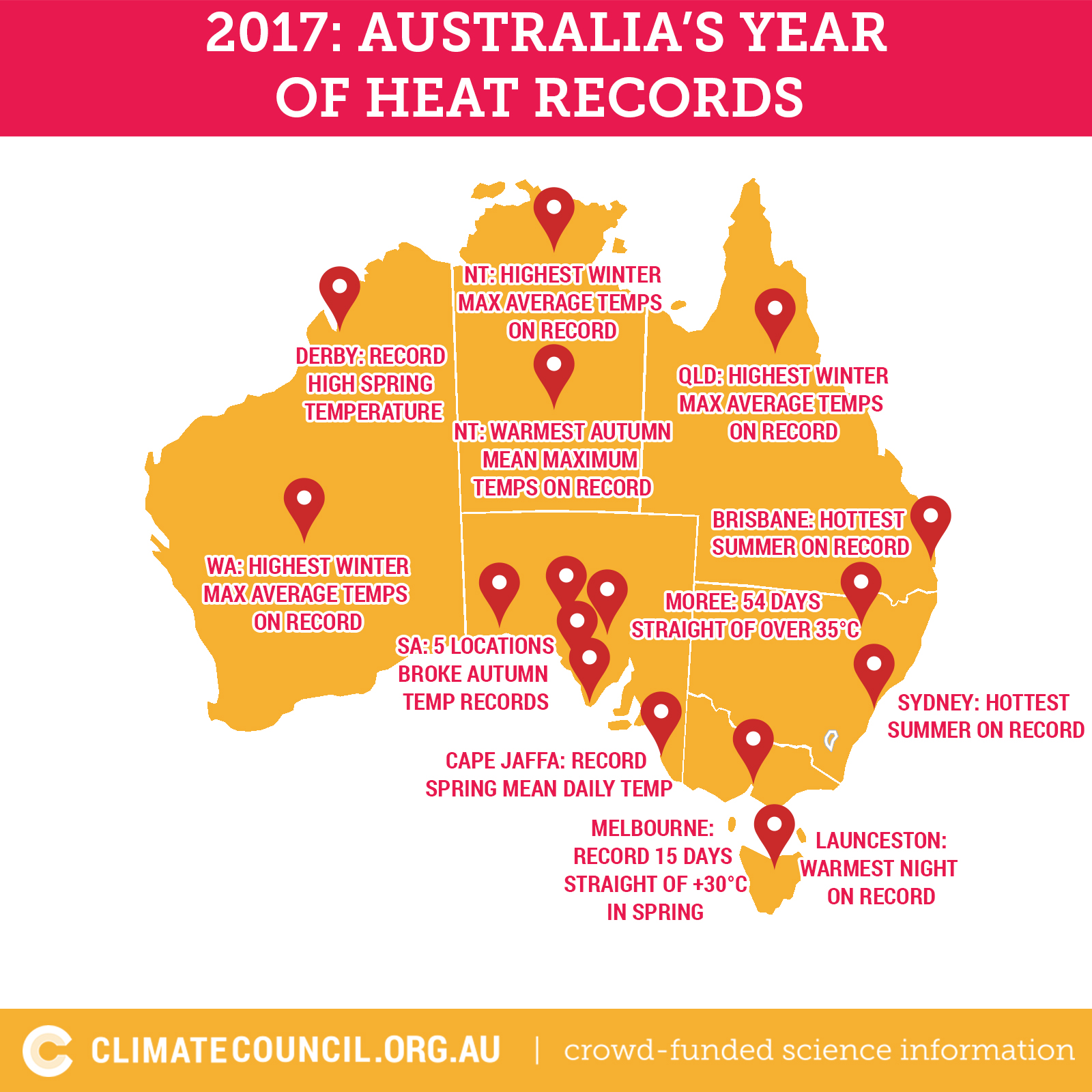
The last 5 years (2013-2017) is officially the hottest period on record. More details are in the Climate Council's report "2017: Record-breaking Year for Heat and Extreme Weather".

This heat graph really tells the story.


There's a bit of variation from year to year. Often are El Nino years are a bit hotter and La Nina years not so much. This next graph colours the El Nino and La Nina years differently. We can see that even La Nina years (blue) are getting hotter, as are the El Nino years and neutral years. Which ever way we look at it we are entering uncharted territory.


The report also found that
  • 2017 was the third hottest year ever recorded, and the hottest year in which temperatures have not been boosted by an El Niño event.
  • The world’s 10 hottest years on record have all occurred since 1998 and 17 of the 18 hottest years on record have occurred this century.
  • 2017 was Australia’s third hottest year on record.
  • Seven of the ten hottest years on record in Australia have happened since 2005. Five of the seven have occurred the past five years.
  • 2017 broke records for hot, dry conditions with more than 260 heat and low rainfall records broken throughout winter.
  • The increasing global heat, driven primarily by the burning of fossil fuels, exacerbated extreme weather events around the globe and in Australia in 2017.
Here's an infographic of the effects in Australia in 2017 alone.
impact of extreme heat in Australia 2017


Thursday, January 18, 2018

How hot will it get in my lifetime?

Want something scary? Type your year of birth (or your child's) into this website.


It's summer in Australia right now and that means heatwave forecasts on a regular basis. Sometimes it's scary to think how much hotter it will get.

Sydney hit 47.3°C (117 F) recently. That's not the kind of temperature you want to add more degrees to.

Thursday, February 23, 2017

Are there jobs in renewable energy?

Some people worry that changing to renewable energy will cost jobs. It's really nothing to worry about. Forbes in the USA did a comparison of the jobs in the various energy sectors and found that already the jobs in solar are double the jobs of all fossil fuels combined.


And that's when solar is only a small fraction of US energy and fossil fuels are about 80 per cent. Imagine what that will look like if solar is 10%, or even 20%.

The future definitely looks sunny for jobs.

Thursday, October 06, 2016

Bad for the planet, bad for your wallet

Divestment Day is this weekend. It's an event where people leave the major banks - who are using our money to fund fossil fuels.

In case climate change is not enough reason to change banks, this data came out recently.


Turns out the the major banks (the'big 4' in Australia) also charge us higher than average rates on home loans.

Perhaps they have to make up for the money they lose by investing in last century's energy sources.

Consumer affairs program The Checkout investigates banks, and finds out that we pay more and get worse service with the big 4.
It was surprising just how much better of we can be with other banks.

Wednesday, August 19, 2015

Australia aims to be the worst

The Australian government has belatedly announced its planned greenhouse emission targets for the United Nations negotiations in December. Australia will take a take of 26 per cent by 2030 to the conference.

For comparison, the Climate Change Authority suggested 45 to 65 per cent by 2030 would be Austalia's fair share.

Of 38 comparable countries only Japan and Norway's targets are weaker, but they've done a lot of work already. Of the 15 most polluting nations Australia is the highest per capita polluter. Based on these targets, that will still be the case 15 years from now.

Friday, May 22, 2015

Poetry and science are different

Just when you think we're all finally all on board to tackle climate change, there'll be someone who doesn't quite get it.

Fortunately there are comedy shows to set the record straight. The relevant part of the video starts at 1min18s.


"There's probably a good reason why the CSIRO doesn't use poetry as data"

There's also a good reason not to listen to people who use bizarre logic to attempt to shy away from addressing climate change. It's like saying "People died before drugs were invented so drugs don't kill people". It starts off with a true statement but then goes into crazy 'logic'.

PS. Sorry, the video also contains a piece on the budget. I'd hoped it was a separate clip.