But today i'm talking about freecycle - an online community where people give away things they no longer need. It keeps stuff out of landfills, and provides people with usable items. At freecycle.org you can join your local freecycle group and start giving (or getting) items.
Wednesday, March 31, 2010
Freecycle
Sometimes we hear about embodied energy - the energy used to make an item. Similarly, items also have embodied emissions. This is one reason recycling is so great - it takes a lot less energy to recycle something than to make a new one from scratch.

But today i'm talking about freecycle - an online community where people give away things they no longer need. It keeps stuff out of landfills, and provides people with usable items. At freecycle.org you can join your local freecycle group and start giving (or getting) items.
See more about:
recycle
Tuesday, March 30, 2010
Earth Hour Winner
Ok, I know it's not a competition, but some of the before/after pics of Earth Hour are fantastic - so i decided to pick a winner. I was just about to award it to Las Vegas (such a stark difference to normal) but then i saw Victoria Harbour, Hong Kong (looks even better if you click for larger pics).


Honourable mentions go to Auckland, my home town Brisbane, Beijing's Olympic Stadium and Toronto (skyline and finance district).


Honourable mentions go to Auckland, my home town Brisbane, Beijing's Olympic Stadium and Toronto (skyline and finance district).
Monday, March 29, 2010
Solar Panels - What's Your Angle?
A friend recently asked me about how well solar panels would work on her east-west roof.
The perfect direction (in the southern hemisphere) is north-facing. But some people (including my neighbour) do face panels west or east if that's the way their roof faces. So how much sunshine do these panels get?

The above diagram (for the UK) and this table (California) illustrate the difference. Here in the southern hemisphere, the same theory applies - just change south to north. So even facing dead-east, a panel still gets 85% of the sunshine that it would get facing north.
The diagram also shows the effect of "tilt angle". The ideal tilt is the same as the latitude of your town. Here in Brisbane it's about 27.5 degrees - not too different from the average roof. But as shown in the diagram, there's a lot of leeway before sunshine is affected much.
Hope that helps. Feel free to comment if anything is confusing.

The perfect direction (in the southern hemisphere) is north-facing. But some people (including my neighbour) do face panels west or east if that's the way their roof faces. So how much sunshine do these panels get?
The above diagram (for the UK) and this table (California) illustrate the difference. Here in the southern hemisphere, the same theory applies - just change south to north. So even facing dead-east, a panel still gets 85% of the sunshine that it would get facing north.
The diagram also shows the effect of "tilt angle". The ideal tilt is the same as the latitude of your town. Here in Brisbane it's about 27.5 degrees - not too different from the average roof. But as shown in the diagram, there's a lot of leeway before sunshine is affected much.
Hope that helps. Feel free to comment if anything is confusing.
See more about:
graphics,
info,
renewables
Wednesday, March 24, 2010
Earth Hour
This Saturday night is Earth Hour. I'm having a 'party' at my place - and i've downloaded one of the impressive desktop background from the Earth Hour website.

All in all, it's a lot of excitement for turning out the lights for an hour. But it's more about the symbolism of the night. This year, over 100 countries are taking part.
Oh, and there are also some tips for reducing your footprint.

All in all, it's a lot of excitement for turning out the lights for an hour. But it's more about the symbolism of the night. This year, over 100 countries are taking part.
Oh, and there are also some tips for reducing your footprint.
Friday, March 19, 2010
Friday Filmclip - Earth Song
I was recently watching Number Ones - the compilation dvd of Michael Jackson. I've liked his music for some time, but have only recently discovered Earth Song.
(oh, and there's a bit of bite right at the end)
See more about:
books and dvds,
clips
Tuesday, March 16, 2010
World Temperatures (now with 2009)
I've previously shown some data about 2009 and the decade 2000-09, but here is the updated world temperature graph.

There's a bit of variation from one year to the next, but it's painfully obvious where the red line is going.

There's a bit of variation from one year to the next, but it's painfully obvious where the red line is going.
Monday, March 15, 2010
10 Commuting Tips
Burning our fuel money away while sitting in traffic jams isn't much fun. The people at SuperGreenMe put together 10 tips for saving fuel and reducing greenhouse emissions.
There's more detail in their article, but in summary the 10 tips were 1. Carpool 2. Walk or Bike to Work 3. Public Transport 4. Telecommute 5. Consider A Four Day Work Week 6. Maintain Your Car 7. Slow Down 8. Combine Errands 9. Stop Your Idle Engine 10. For Your Next Car, Think Fuel-Efficient
Friday, March 12, 2010
Friday Funnies - Olympic Podium
Being the season of Winter Olympics, i'm sharing this gem from Inkcinct

I do note, that the 'athletes' have been awarded NO medals. And rightly so.

I do note, that the 'athletes' have been awarded NO medals. And rightly so.
See more about:
funnies
Tuesday, March 09, 2010
Our Choice
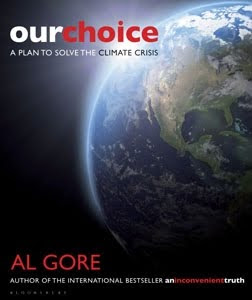
I finally managed to find a library copy of Our Choice - Al Gore's 'sequel' to An Inconvenient Truth. And it was definitely worth the wait.

Somehow it manages to combine the information of an encyclopedia with the easy-reading style of a magazine, using plenty of full-page colour photos, and a few diagrams and charts to explain some things. [See Inside the Book]
While some read (or watched) An Inconvenient Truth and went away with a feeling of impending doom, Our Choice tells the next part of the story - that there is hope ... provided we have the will to take action. (Hence the title)

Somehow it manages to combine the information of an encyclopedia with the easy-reading style of a magazine, using plenty of full-page colour photos, and a few diagrams and charts to explain some things. [See Inside the Book]
While some read (or watched) An Inconvenient Truth and went away with a feeling of impending doom, Our Choice tells the next part of the story - that there is hope ... provided we have the will to take action. (Hence the title)
See more about:
books and dvds
Friday, March 05, 2010
Monday, March 01, 2010
The Clean Industrial Revolution
From time to time we hear some pish-posh about reducing greenhouse pollution damaging the economy. Generally, there are helpful people who show such claims to be clearly false. Ben McNeil goes one step further in his book The Clean Industrial Revolution, saying that it would harm the economy if we don't reduce pollution.

He puts forward a compelling and well-researched case - saying the question for Australia isn't 'can we cut emissions without hurting economic growth' but instead 'can we grow our economy without cutting emissions'. (His conclusion is 'no')
One example of economic benefit is the comparison of New South Wales and Denmark. Coal in NSW provides 90% of the energy, but only 11,000 jobs. Denmark has a slightly smaller population, and wind power is just 20% of the energy, yet it gives 20,000 people a job.
He puts forward a compelling and well-researched case - saying the question for Australia isn't 'can we cut emissions without hurting economic growth' but instead 'can we grow our economy without cutting emissions'. (His conclusion is 'no')
One example of economic benefit is the comparison of New South Wales and Denmark. Coal in NSW provides 90% of the energy, but only 11,000 jobs. Denmark has a slightly smaller population, and wind power is just 20% of the energy, yet it gives 20,000 people a job.
See more about:
books and dvds
Saturday, February 27, 2010
I'm Even Further In Front
A little while back, i calculated the financial benefits of my energy savings. It's been a while, so i thought i'd repeat the exercise - now that i'm even more energy efficient.

Compared to 4 years ago, i'm saving $55.79 per bill. Of course, i subscribe to 100% greenpower which (on my last bill) cost me $26.23

End result? I've reduced my electricity-related emissions to ZERO, and i'm still in front by about 30 bucks.

Compared to 4 years ago, i'm saving $55.79 per bill. Of course, i subscribe to 100% greenpower which (on my last bill) cost me $26.23

End result? I've reduced my electricity-related emissions to ZERO, and i'm still in front by about 30 bucks.
See more about:
greenpower,
savepower
Thursday, February 25, 2010
100% Renewables by 2020
The people at Beyond Zero Emissions have just released their Stationary Energy Sector report. It is part of their Zero Carbon Australia project, and details exactly how Australia could move to 100% renewable electricity by 2020.

With Australia being as sunny as it is, the main component is Concentrated Solar Thermal (pictured above) which focusses sunlight on a central tower. The enormous heat that is generated is then converted into electricity (even after dark).

The above map shows where the solar stations (yellow) and wind farms (blue) could be located in order to provide the reliable supply of electricity we are used to. In extreme circumstances, biomass and hydropower are ready as backups.

With Australia being as sunny as it is, the main component is Concentrated Solar Thermal (pictured above) which focusses sunlight on a central tower. The enormous heat that is generated is then converted into electricity (even after dark).

The above map shows where the solar stations (yellow) and wind farms (blue) could be located in order to provide the reliable supply of electricity we are used to. In extreme circumstances, biomass and hydropower are ready as backups.
See more about:
renewables
Friday, February 19, 2010
Hot Planets
Being the nerdy sciency type, i've been watching a documentary on the solar system. It reminded me about the planet Venus.

As we know from school, Venus is about halfway between Mercury (average temperature 167°C) and Earth (15°C). So we might expect Venus to be somewhere between fifty and a hundred. However, with an atmosphere composed mostly of carbon dioxide, the average Venusian temp is 464°C.
[source: NASA planetary data sheet]
As we know from school, Venus is about halfway between Mercury (average temperature 167°C) and Earth (15°C). So we might expect Venus to be somewhere between fifty and a hundred. However, with an atmosphere composed mostly of carbon dioxide, the average Venusian temp is 464°C.
[source: NASA planetary data sheet]
See more about:
info
Tuesday, February 16, 2010
Teach Yourself Energy Saving
From the teach yourself series, Nick White's book on saving energy in the home contains many references to British programmes and government initiatives. So much so, that i almost didn't bother writing about it.

But i was convinced by the middle half of the book, which contains a range of energy saving tips for different areas of the home. The majority of these are just as applicable to Australian homes as to the British ones.

But i was convinced by the middle half of the book, which contains a range of energy saving tips for different areas of the home. The majority of these are just as applicable to Australian homes as to the British ones.
See more about:
books and dvds,
tips
Subscribe to:
Posts (Atom)