Showing posts with label theworld. Show all posts

Thursday, August 01, 2024

Today is Earth Overshoot Day

Yes it would be great if humanity just used resources at the rate the earth can produce them. But we don't. We use way more.

At the current rate, by August 1 we consume a year's worth of Earth's resources. This would be OK if we had 1.75 Earths - but we don't.

What's worse is that they've also calculated the Earth Overshoot day, and how many earths we'd need, based on the consumption of each country. 

If everyone consumed like Australians, we'd need 4.7 Earths (our overshoot day would be 5 April). For the USA it's 5 Earths (an overshoot day of 14 March).


Click the images for larger size versions, or see more graphics on Overshoot Day.

Thursday, November 24, 2022

Carbon World Cup

How will Australia go in this year's World Cup? That's the big sporting question in Australia at the moment. Other teams in Australia's group are France, Denmark and Tunisia. Statistically, Australia should probably lose all three games.

If the game was carbon pollution, Australia would be the highest scorer by far. Our nation out-pollutes Denmark by 3 to 1, France 4 to 1 and Tunisia 6 to 1. Those scores would be great in soccer, but in climate change they are terrible for Australia - and for the world.


In fact in the hole tournament, the only country that could match us would be host nation Qatar. That's the level Australia is at. As a nation we've got a lot of improving to do - and I don't mean in soccer.

Monday, August 19, 2019

Australia sinks island hopes

At the recent Pacific Island Forum, Australia has appeared to prefer burning coal to saving lives

The leaders of the Small Island States had all agreed to a declaration for stronger action on climate change. Perhaps not surprising considering these nations' future existence is at stake. But then Australia stepped in.

Instead of giving them what they need (action on climate change) Australia gave them foreign aid money. Cartoonist Cath Wilcox illustrated how (not) useful that is.


And even worse, it's not extra money - it's been redirected away from other foreign aid programs.so orther worthy programs no have to go without.

So basically Australia, having heard that climate is the biggest issue for all these Pacific Island nations is not giving one extra dollar and not reducing pollution by one single gram.

Back in Australia, the Deputy (and acting) Prime Minister made some bizarre remarks about fruit-picking, and also,

“I also get a little bit annoyed when we have people in those sorts of countries pointing the finger at Australia and say we should be shutting down all our resources sector so that, you know, they will continue to survive,”

Two things here. First is the exaggeration/lie about what was being asked - it was only ever about coal. Second is the display of priorities where he seems to be saying that a polluting industry is more important than people's lives - that he wants to continue burning and exporting coal forever - even if it wipes out several nations along the way. Stunning.

Monday, August 12, 2019

Climate Change: The Facts - by David Attenborough

If you missed last night's ABC screening of Climate Change: The Facts here's the link to see it on iview.

David Attenborough's Climate Change: The Facts

There's an explanation of climate change, it's impacts and what we can do to reduce it. Being a David Attenborough documentary it also contains some amazing footage:

  • Australian bats littered on the ground after a heatwave, (perhaps turn away at that point if you're an animal lover)
  • Dashcam footage as a father and son driving through a bushfire to escape it - only to realise that was impossible, (their escape was quite miraculous)
  • Flames coming out of ice. This was a demonstration of the quantity of ice-trapped methane in the permafrost. When this permafrost melts (due to climate change) this methane will be released and cause even more climate change. This is what's called a tipping point.

There's also amazing stats:

  • British heatwaves are 30 times more likely than in the 70's.
  • Greenland is losing ice at 5 times the rate that it was just 25 years ago.
  • The US state of Louisiana is losing land the size of a football field every 45 mins - due to sea level rise - and already people have had to abandon their homes.

Sometimes our tendency is to avoid change even when it's necessary. It's important to remember that the "cost of action is dwarfed by the cost of inaction".

Some more David:
David Attenborough's Great Barrier Reef

Monday, July 29, 2019

The Earth can't keep up

If you spend your whole year's income in 7 months, that's not good. That's what we're doing to the Earth.

Today (29 July 2019) is Earth Overshoot Day. That's the earliest it's ever been. Already this year we've used up a year's worth of natural resources. To put it another way, what we use in a year takes 1.7 years for the earth to regenerate.


It hasn't always been this bad

In 1970 the date was at the end of the year. We were using the exact amount of resources that Earth could replenish. Yes, there's more people today, but with our advanced technology and better choices we can get our of ecological debt.

Australia hasn't improved

If everyone behaved like Australians, we would need 4 Earths to sustain us. Our overshoot date is March 31 (same as last year) and is one of the worst. (Yes, the USA is still a bit worse).


Is your country not here?

See if you can find your country on this calendar. (The later your country's overshoot date, the better).

Wednesday, April 03, 2019

Climate for Change

When the media and politics talk climate change there's we hear a lot about renewable energy versus coal. Fair enough, electricity does account for 34% of our country's emissions.

But what about the rest? ABC's Four Corners program did this documentary about Australia's emissions, where we are compared to the rest of the world, and what can be done to improve.

Here is my quick summary. You can also watch it online, or read the transcript.


Transport

19% of emissions
Transport emissions are growing because our population is growing and our demand for transport is increasing. Our vehicles are improving but not quickly enough to match our increased use.

We currently have no emission standard on vehicles. In the USA and Europe vehicles are more efficient and cheaper to run.

Some countries have already started phasing out petrol and diesel cars in favour of electric vehicles. Norway is the leader with 31% of new cars being electric. In Australia it's 0.2%.

Even in the UK, there are 29 affordable models of electric cars (under 60,000 AUD). Here in Australia we have 4.

Industry

30% of emissions
Australia is the world biggest exporter of natural gas (LNG). If the countries that buy this gas are burning it instead of coal, that's good for world emissions. But Australia's emissions are higher because of the energy used to extract, liquefy and transport it.

The industry's rate of improvement in energy use and carbon intensity is at the bottom of world standards. Why?

Australia has a 'baseline' system where big polluters are each given an emissions cap. If they exceed that cap they are penalised - at least in theory. One-third of big polluters have been allowed increase their cap. Emissions from these polluters is up 12% in the last four years.

The rules around changing the cap we changed last month. Bizarrely, they make increasing the pollution cap even easier.

Agriculture

15% of emissions
Agricultural emissions is usually a hard area to find reductions. There are a lot of methane emissions from livestock. However, Australia's science agency CSIRO has discovered a natural feed-additive that reduces livestock emissions to almost zero.

Electricity

34% of emissions
Electricity emissions are trending down as renewables replace coal and gas. Transgrid, the network operator in NSW say the last time they connected a coal power station to the grid was 1992. Wind and solar are very affordable now.

French company Neoen started in Australia in 2012, and now have built half their global capacity here. They say a long term goal is needed and that such a goal is not a burden but a certainty for investors.

At the moment 2/3 of Australia's power still comes from coal. These power stations are old and due to close. We need to start soon and do so in an orderly fashion, so that they don't all close at once.

Current Policies

The current government buys carbon reductions by giving money to projects that reduce emissions. Sounds good in theory, but there are two issues.

As discussed earlier, companies are being allowed increase their pollution so this "emissions reduction fund" is not reducing emissions, just trying to make up for industry's increase.

Secondly, some projects would still occur without the government funding. So we're spending money on projects that would happen anyway.

In short we're spending money we don't have to spend and emissions aren't reducing.

International commitments

So how will we meet our Paris target of a 26% reduction in emissions? The current government is looking to use "credits" from a previous time period where we met our targets.

One of the experts on the documentary said it's like failing your year 12 exams and trying to increase your mark because you got excellent results in year 8.

Also the Paris meeting was held in 2015. Next year all the nations gather again and are expected to improve their targets. The way we're going we can hardly reach the weak targets we currently have.

Conclusion

Despite Australia doing so poorly at the moment, there is much hope when we see what is possible. One of the experts has the opinion that "when the debate is over, the economy and people will move forward and take a lot of advantage". I'm looking forward to that.

Wednesday, August 01, 2018

When does your country overshoot?

If you spend your whole year's income in 7 months, that's not good. That's what we're doing to the Earth.

Today (1 August 2018) is Earth Overshoot Day. Already this year we've used up a year's worth of natural resources.

Clearly, we can't keep going like this - unless we have a second Earth to farm, fish, pollute and dump our waste on. One Earth just can't handle all we're doing.

Australia really bad

Worse still is that countries like mine are chewing through resources even more recklessly. If everyone behaved like Australia, Earth Overshoot Day would be 31 March. That means we'd need four Earths!

How does you country compare?

Here's where that day falls for other countries. See if you can find your country. If it's not there then your country is being responsible. (Click for a larger image).


Let's not wait until it's too late

It really is like we're spending more every year than we earn. Do we have to wait until our savings have all disappeared? Hopefully we take action earlier than that - and have a long-term future on the one Earth we do have.

Friday, July 06, 2018

The cleanest nation in soccer

With the quarter finals about to start, here are the greenhouse emissions (per person) of the nations competing.


Obviously I'm going to be cheering for the cleaner teams in each game. If all goes to plan Brazil will meet Sweden in the final and win. Three teams on my scoreboard are on 5 - but Brazil's 5.03 is slightly better that Sweden's 5.28 or Croatia's 5.49.

Having said that, I'd be OK with any of those three nations winning. They are all cleaner than the world average of 6.27 and far and away better than Australia's pathetic 25.

If only our emission could learnt a lesson from soccer - and take a sudden dive.

Thursday, June 28, 2018

World Cup of Polllution

Australia has been eliminated from the Soccer World Cup, again. As I looked at the points table for Group C, I wondered how these nations compare in terms of greenhouse gases.

Here are the scores:


Not only does Australia pollute more per person than any of these nations, but the average Australian pollutes more than a French person, a Dane and a Peruvian combined.

These other nations are better at soccer and better at taking care of the planet.

And it's not just group C. It turns out that Australia is the highest polluting nation at this World Cup at 25 tonnes of greenhouse emissions per person.

Next worst is Saudi Arabia at 18 and Russia at 15. Hardly anyone even has half the greenhouse emissions of Australians.

Wednesday, August 02, 2017

Earth Overshoot Day - How did you do?

We're using up resources faster than Earth can replenish them. And we're creating waste faster than Earth can deal with.

With our current habits, we'd need 1.7 Earths (which we don't have).

In other words, we used up Earth's 2017 capacity by today, 2 August.

Some nations are even more wasteful. This graphic shows what the Overshoot Day would be if everyone lived like people from that country.


Australia is the third most wasteful in the world, using up a year's resources by 12 March.

You can find out your own personal footprint. How many Earths would we need if everyone lived like you?


If you'd like to reduce it, consider taking one of the pledges.

Thursday, June 09, 2016

Countries moving on

There's a whole bunch of countries who have recently made big moves in energy.

The UK's energy from coal has hit zero, Portugal has run entirely on renewable energy for the past four days and Denmark produced 140% of its energy needs from wind power, exporting clean energy to Norway, Germany and Sweden. Here at home, Tasmania has returned to 100 per cent renewable energy and South Australia has disconnected its last coal power station.

Monday, August 24, 2015

New Zealand beats Australia again

New Zealand will shut down it's last two coal power stations.


Prime Minister John Key, noted that coal plants "aren't the most sensible plants to have", saying renewables will go from 80 to 90 per cent and beyond.

Way to go, New Zealand.

Wednesday, August 19, 2015

Australia aims to be the worst

The Australian government has belatedly announced its planned greenhouse emission targets for the United Nations negotiations in December. Australia will take a take of 26 per cent by 2030 to the conference.

For comparison, the Climate Change Authority suggested 45 to 65 per cent by 2030 would be Austalia's fair share.

Of 38 comparable countries only Japan and Norway's targets are weaker, but they've done a lot of work already. Of the 15 most polluting nations Australia is the highest per capita polluter. Based on these targets, that will still be the case 15 years from now.

Thursday, June 18, 2015

The End of Coal?

ABC's Four Corners did a great episode on Australia's obsession with coal, asking whether we are putting all our eggs in one basket, and if that basket is about to break?

"The reality is: the transition is happening irrespective of what Australia does."
"The world is committing to a low-carbon future. Australia's challenge is not to be left dependent on coal if the rest of the world leaves it behind."


The report included 1960s footage of one of Australia's coal power stations when it was new. Odd to think we're still relying on that technology.

It was also stunning to see the unwavering dogmatic belief of coal executives regardless of all the economic data. With comments like "I simply don't accept that..." it's understandable that cartoonists draw the industry as ostriches with heads in the sand.

The overall message is clear. It doesn't matter how much of a resource we have. If nobody wants to buy it, then it's a waste of money to invest in digging it up. Or as one of the economist puts it:

"What happens to Australia and our national prosperity if coal becomes a less and less valuable commodity? In many ways the current Government and Australia as a whole is doubling down on coal. And we're doubling down on a technology which is 100 years old, and which is rapidly being out-competed in many parts of the world by new technologies that are cleaner and superior in many ways, that have outlook of just lower and lower costs through time."

Saturday, November 15, 2014

Mother Nature's sense of irony

Australia is a large country, but our heatwave (like the world's leaders) has honed in on Brisbane this weekend.

Map of Brisbane's heatwave 14-16 November 2014

The irony is that G20 hosts Australia have refused to put global warming and climate change on the agenda. This has provided lots of material for cartoonists.

Cartoon: Australian Prime minister ignoring heatwave and US-China Climate deal at G20 meeting

Meanwhile, down in Sydney, a group of 400 people have paid tribute to the Australian government's attitude to climate change by sticking their heads in the sand.

400 people at Syndey's Bondi Beach poking fun at the Australian government's ignorance of climate change

Related G20 links:
USA and Chine lead the way - the game-changing agreement
Should Merkel shirtfront Abbott - a farmer's plea
Climate Change at the G20 - satire video
The Banned Ads - and the conflict of interest
G20 or G19? - cartoon

Thursday, November 13, 2014

USA and China lead the way

The USA and China have announced their biggest climate change deal.

This agreement reduces carbon pollution by the equivalent of the entire world's emissions from 1990-2013.

Australia's position, coming into the G20 meeting is best summed up by this cartoon.

David Pope's cartoon showing China and the US working on climate change solutions with Australia represented as a child playing off to one side.

Or maybe this cartoon of the G20.

And while the future commitments are great, China is already doing some amazing things. The Climate Council posted this summary before the announcement.

Infographic of China's carbon reduction achievements

It's an impressive set of statistics:
  • 1st in renewable energy capacity and investment
  • 2.6 million jobs in renewable energy
  • in 5 years have shut down more coal power than exists in Australia

Friday, November 07, 2014

Should Merkel shirtfront Abbott?

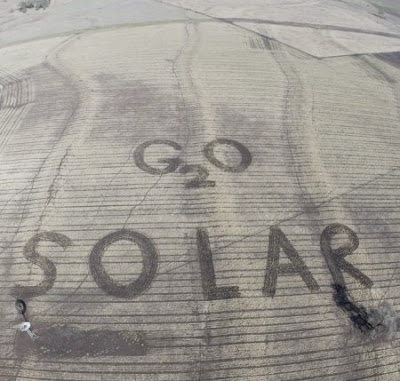
I love this "Go Solar" message - made with a plough by a Queensland farmer.


Obviously with extra "2" is a reference to the upcoming G20 meeting. When asked, the farmer said "I hope Angela Merkel shirtfronts Tony Abbott and asks him, if Germany can go solar then why on earth can’t Australia?".

(For non-Australian readers, the word 'shirtfront' is a reference to a bizarre comment recently made by Abbott.)

The farmer also summed up the issue quite well:

Farmers are at the pointy end of climate change. Last year was our hottest on record, this one’s shaping up to be even worse, and we’ve got a raging drought over a vast area. In spite of the overwhelming scientific evidence, our idiotic politicians are hooked on coal and gas, which is the cause of the problem.

We have huge reserves of sunshine, so making use of it is simply a matter of common sense. Our government’s reluctance to do so is an international embarrassment."

And if the farmer's word about the drought wasn't enough, the overhead shot certainly shows just how dry the land is.

Thursday, November 06, 2014

Climate Change at the G20

Australia decided to avoid talking about climate change at next week's G20. As usual, the Roast summed this up brilliantly, describing other nation's attitude as:
At a forum to discuss the economy it's a good idea to mention the planet that economy happens on.

Tuesday, October 21, 2014

Uruguay - You are Great

At the recent UN Summit, Uruguay committed to reduce its greenhouse emissions by 85% by 2030.

Uruguay commits to reducing emissions by 85% by 2030

Of course there are many other nations with admirable and responsible commitments. (Not Australia though. Still just a 5% reduction)

I've been tagging all my posts like this one, about other nations doing great things, with the tag 'the world'.

But the Climate Council has put it all together in a clickable map.

Thursday, September 25, 2014

Australia at the United Nations (sort of)

Comedy program The Roast once again provides great coverage of current events, while being funny at the same time. (I might have mentioned that before).

This week it was the UN Climate Summit, the no-show by Australia's PM, and several related actions of the government here.


It's quite sad that when world leaders meet to act on climate change, Australia's leader isn't there. But at least it provides good material for comedy programs.

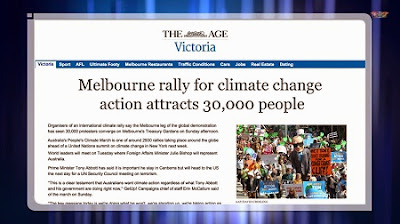
30,000 rally for climate action in Melbourne