Friday, July 30, 2010

China To Put Price On Carbon

When looking for excuses for doing nothing about climate change, one poitician favourite is the one about waiting for the rest of the world. Apart from being illogical, it's also becoming more and more misleading. In addition to India putting a tax on coal, now China is preparing to start an emission trading scheme.


The move is described as "essential" and industry experts said that putting a price on carbon is crucial for the country. Interestingly, administrative measures (or what some Australian politicians call "direct action") have been found to be less cost-effective than simply putting a price on carbon.

Tuesday, July 27, 2010

Election Scorecard

In the lead up to the election the ACF is putting out an election scorecard on 4 issues related to climate change. ACF also point out that three-quarters of Australians think we are too dependent on polluting energy sources, and 92% are concerned about the damage pollution is causing.


At the moment, two parties are nowhere near a pass mark. As of this morning, the overall scores are as follows:


Let's hope more announcements are made, and parties can increase their mark.

Friday, July 23, 2010

Are We Dumber Than Fish?

Regular readers know my liking for ABC's Catalyst. A little while ago they did a story on groups of animals making collective snap-decisions.


From research on fish, it seems that the bulk of the group will wait for the 'expert' fish to make a decision, then everyone will follow immediately. Not only are the decisions made quicker (because the expert is deciding) but the accuracy is also far higher than when each fish is left to decide for itself.

I'm sure the link to climate change is obvious. We have the expert advice on what actions we should take - but how quick are we to act? I'm sure if fish were this slow to act, they'd by shark-lunch by now.

Thursday, July 22, 2010

India Puts Price on Carbon

One of the flimsy excuses for doing nothing on climate change is the line about waiting for the rest of the world. It's irrational because if every nation thinks that way, nothing will ever happen. But it's also misleading because so many nations are already doing so much more than Australia (and the US).


This week I read that India has introduced a carbon tax on coal. It is expected to raise 25 billion rupees (535 million dollars) which will be used to fund renewable energy.

Meanwhile Australia doesn't even have a carbon price - and the government isn't promising one anytime soon. Apart from the effect on our planet, it's also kind of embarrasing that a developing country like India is ahead of us - a so-called "advanced country".

Wednesday, July 14, 2010

Soccket Ball

Solving carbon emissions, and health at the same time - that's what the sOccket does. It's the soccer ball that generates energy as it moves, using a small magnet inside the ball.


15 minues of play generates enough energy to run an LED light for 3 hours. This eliminates the need for kerosene lamps - which can have the same effect as smoking 2 packs of cigarettes a day. Burning kerosene is also responsible for 190 million tonnes of carbon emissions each year.

The makers hope to sell them in developed countries, and use the profits to fund distribution in places like Africa.

Tuesday, July 13, 2010

Coffee With Julia

The people at GetUp have recently made this ad for tv - and people are donating to get it on the air. I enjoy their work, because it's both witty and to-the-point.


They sum it up greatly, with a leader saying "Climate change is our greatest challenge ... but it can wait", and the guy from the general public saying "Why don't you just put a price on pollution?"

Thursday, July 08, 2010

100% Renewables With Energy To Spare

Regular readers have experienced my fondness for graphics - and won't be surprised that i liked this one. It comes from Zero Carbon Australia, who's plan for Australia to be on 100% renewable power i have mentioned before.


The orange and blue in the bottom represent the solar and wind power that would meet Australia's demand for electricity. The small bits of green and navy are the occassions where biomass and hydroelectricity would make up the shortfall, and the light orange/yellow at the top represents the massive amount of excess energy that would be produced.

So much for that theory that renewables can't provide our energy!

Wednesday, July 07, 2010

State Of Origin Score

As we go into game 3 of rugby league's State of Origin contest, it seems that Queensland dominate almost as much on the renewable energy scoreboard.


This is the percent of Queensland and New South Wales households that choose greenpower (renewable energy) from their electricity company.

Of course if this is the score in the rugby league state of origin, that would also be fine with me. :)
-----------------
(PS: Yes NSW fans, i know i do this at every state of origin. Perhaps i'll stop if ever NSW catches up ;)

Thursday, June 24, 2010

1 Day Of Driving

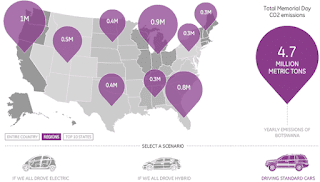
You know how i like a good graphic. Well the people at GE have put together an interactive display of America's car emissions for their recent Memorial Day holiday.


The encouraging bit is clicking on hybrid car or electric car and seeing the total emissions shrink. The discouraging bit is that one day's car emissions (right of screen) are equal to the total annual emissions of some smaller countries.

Monday, June 21, 2010

Solar Panel Heat-Map

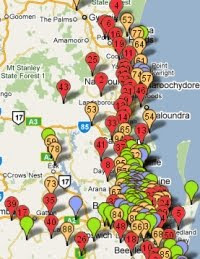
According to Energex, the are 19,982 dwellings with solar panels (in South East Queensland) which totals up to 33,109 kW of power.


Adjusted for the number of households, the above map shows the uptake of solar power. It ranks the postcodes by kilowatts of solar power per household. The top 50 postcodes are coloured red - the next fifty orange, then green then blue.

If you click through to the map, there is also a rankings list, so you can see exactly where your neighbourhood comes in.

Thursday, June 17, 2010

Solar Savings

Previously, i showed a graph of how much solar panels can save you each year - depending on much energy you use yourself - and how much excess you produce. In my latest bill from Origin, they did some calculations based on a home using 50% of the energy from the panels.


Of course, often the major energy use is outside of the main sunshine hours, so it is possible to sell back more than 50% of the solar energy to the grid - and take even greater advantage of the Solar Bonus Scheme.

(Oh, and the 50c/kWh in the calculation is Origin's special offer. The guaranteed rate set by the government is 44c/kWh. How nice of Origin :)

Thursday, June 10, 2010

New Jobs Map

A few weeks ago, i wrote about the Creating Jobs Cutting Pollution report - showing that the stronger the action from government to reduce emissions, the more jobs that are created.


Since then, the talented graphics people at ACF have put this information into a far more fun and colourful form - an interactive map. Try it out!

Wednesday, June 09, 2010

Living In Denial

New Scientist magazine has just done a special on Living in Denial. It's not exclusively about climate change denial - it also refers to vaccines, evolution, and smoking-induced cancer.


It includes articles on the difference between scepticism and denial, why sensible people reject the truth and how corporations manufacture doubt. It's an interesting read.

Tuesday, June 08, 2010

Crude

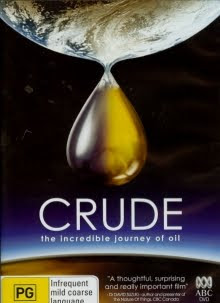
This DVD documentary Crude begins by explaining how oil got to be there in the first place (starting around 160 million years ago) and how much we have become addicted to it (and not just for motoring).


Consuming it at a rate of 84 million barrels per day, "we're all of a sudden dependent on rapidly shrinking supplies of evermore expensive oil"

It's tempting to think that perhaps running out of the stuff might save us from climate change, but Jeremy Leggett does the maths...
The latest work of the climate scientists says we can "afford" to put into the atmosphere another 400 billion tonnes of carbon. Well, you just look at what's left in fossil fuel reserves below ground. You've got 700-plus in oil alone. Then you've got 500 billion in gas. And coal - forget it - it's 3500 billion and counting. So we can cook our planet many times over

Having switched from exploration geology to a solar company, he explains that
My abiding fear is that i'll live through what remains of my vocational life in an exciting fast-growing company while the world is going to hell in a bucket because of the stupid addiction to oil we've had all these years and the effect that it will ultimately have on our economies ... plus of course, the unfolding effects of global warming, which just get worse by the month.

The DVD ends with this
Every year we burn more and more of what we have less and less of. Are we mining the aftermath of past climate catastrophes, simply to engineer our own?

Monday, June 07, 2010

Office Recycling

At a meeting in the city last week i spotted these great office recycle bins.


As well as tiny knee-high ones (suitable for seated office areas) they also had waist-high ones convenient for standing areas like kitchens, photocopy areas - or corridors (as demonstrated by Stuart).


Being a government building, i'm sure they were also there to promote the state government's Do The Right Thing initiative, which (among other things) lends recycling facilities for events and festivals.

I've mentioned before that recycling one aluminium can saves enough energy to power a TV for 3 hours. Now i find out that recycling one plastic bottle saves enough energy to power a light bulb for 30 hours. Wow!