Showing posts with label CFL. Show all posts

Wednesday, March 21, 2018

Choosing the right lights

Often there's a mental barrier to getting energy-saving lights. They cost money.

Is it worth it?

Yes. Even if you're renting. For your main lights, most upgrades make their money back in less than a year.

The Checkout did the maths for a light that's on 5 hours per night at a price of 30 cents/kWh.

How much do I save with an energy-saving light

A six dollar bulb can save you around $20 every year! That's an amazing return on your money.

Plus they also last longer. So in the long run you save even more by not having to replace them as often.


The video also mentions the Light Bulb Saver app. It's handy for calculating the saving for your particular situation and is available on Google Play and iTunes.

Thursday, November 28, 2013

Economy or Ego-nomy?

A guy at work was saying "you don't get a return for the money you spend on CFL light bulbs". So I decided to join the conversation, mentioning that a single one can save you $25 dollars per year - assuming 4 hours use each night.

He said "Sure, for those ones. But what about the ones in rooms you hardly ever use?". Later I did the math. It turns out that even a room that gets used 8 minutes a night (like a toilet for instance) is still worth switching to CFL.


But here's what I found odd. People will worry about whether it's worth buying a $3 CFL to save on energy, but are happy to pay $30,000 to $100,000 more for a house with extra rooms they obviously don't need.

That night a friend commented to me that the problem is not the economy, it's the ego-nomy. Her theory is that we could easily consume less energy and material goods - and actually be better off, psychologically and economically. But ego-nomically we might struggle. It seems that society strokes our ego only when we can point to (wastefully) expensive purchases.

I hope that changes. It would be great if the admired decisions were those which are good for us, good for society and good for the planet.

Monday, April 29, 2013

The Most Ridiculous Thing

The Canadians have this great ad. I like the tag line:
The most ridiculous thing about wasting power is that for some reason we don't think it is ridiculous.


It's part of the campaing for Powersmart, and it's one of those ads that's funny because it's true. We wouldn't waste other things the way we waste energy.

For instance, old-style lightbulbs use 5 times the energy of CFL spiral-style bulbs. It's hard to think of anything else where we would buy 5 times as many as we need.

UPDATE: See the sequel ad - the workplace version.

Wednesday, April 03, 2013

CFLs $1.87 each

From this Saturday, Aldi has 8-packs of CFLs for $14.99. If you haven't already replaced your old-style bulbs, this is a great opportunity to do so at hardly any cost.

Compact fluorescent lamps on sale

Unfortunately, the ad is a bit scarce on detail, like the wattage. I guess we'll find out on Saturday.

Remember to divide by 5 the wattage of the old-style bulb to get the wattage of CFL that will replace it. That's an 80% energy saving!

Monday, March 18, 2013

More Bargain LEDs at Aldi

This week Aldi have some bargains on LED lighting. If you haven't yet changed your old-style incandescents, you can pick up one of these LEDs. They're also the same shape as the old ones (if you're not a fan of the CFL 'spiral' look).

LED bulbs - incandescent replacments

As for brightness, the 4W is equivalent to a 25W incandescent bulb. The 6W equal to 35W old-style, and the 8W equal to 48W (note: see the update below). By the way, I calculate switching one 60W old-style to an 800 lumen LED (10W), would save $18.50 in energy each year (assuming 4 hours use per night).

Also, if you've got lamps with small finnecky bulbs that were hard to match in CFL, there are also some LED equivalents for these.

LED bulbs - small incandescent equivalents

As before, these Aldi sales are limited stock, so if you're reading this in April, don't get your hopes up.

UPDATE: By the time i went on saturday, there were no 10W's left in that store - and only a few 8W and 6W. In terms of brightness, LEDs are improving al the time. While these ones were a big bargain at $10.99, for a bit more money you can get even more efficient ones - like a 5W (400 lumens) to replace a 60W bulb, or a 10W (810 lumen) to replace an old 100W bulb.

Monday, September 10, 2012

Calculate Your Savings (Lights)

If you still have incandescent lightbulbs in your house, here is the tool for you. A calculator that can show you the huge savings of switching to CFL lighting.


Just put in the number of bulbs, and their nightly run time, and it will tell you how much could save. It tried some numbers of a typical house, and found a fairly substantial saving of $213.


It's much more user-friendly than my old method.

Monday, November 07, 2011

Tip 1 of 10

Recently I was at Sustainable House Day and this banner of tips was displayed at one of the homes.


The first tip was one of my favourites - energy-saving bulbs. On the banner it says that replacing five lights with CFLs will save (every year) around 450kg of CO2 and about $70 from your wallet - and that's in just one year! You can see why it's one of my favourites!
Note: This saving would have increased with the price of electricity since the printing of the banner

Move on to Tip 2 >

Tuesday, January 11, 2011

Easy Energy Cost Calculator

When i'm doing energy assessments, often people like to know how much energy different items use. To save on mental arithmetic, i put this little table together to work out the annual cost (using local electricity prices).


Standby power - If a stereo is using 5 watts (all day) on standby. How much does that cost? $9/year.

Light bulbs - How much do the new ones save? Let's find out. 75W bulb, 5hrs a night, $29. Equivalent CFL (15W) for 5hrs, $6. Saving of $23.

Computers - A laptop consuming 40W for 5 hours a day costs $16 a year to run. (Using the 20W figure and doubling it.)

Tuesday, December 01, 2009

Climate Smart Meter

Sometimes we take things for granted. I met some NSW people last week, who wished their state had something like the Climate Smart Home program. One of the reasons is this great little energy meter, that can tell you how much power you are using at any moment. (It can also has a money mode and a greenhouse gas mode.)


Apart from the meter, the deal includes free energy efficient light bulbs, and a water efficient showerhead. And if you live in Brisbane, the city council will reimburse you the 50 dollars.

Monday, October 19, 2009

Actions Animation

Found lots of great stuff during last weeks international blog action day on climate change. The first one i want to share with you is this quick little video by Brazil's WWF.


The message is great, and the rhythm of the backing music is quite infectious. I can't help but play it over and over.

Monday, December 08, 2008

Home Service

Following on from Friday's theme of good deals... I have recently signed up for the Queensland Government Climate Smart Home Service. They send an expert round to my house, and he does an 'energy audit' to find places where i can save energy (and money).


As part of the deal, i get a free water-efficient showerhead (saving water and energy) and up to 15 energy-efficient light bulbs. But the coolest part is the free wireless energy monitor which tells me how much power i'm using.
----
ps. i probably should mention that the service costs $50 - but it's great value - the lightbulbs alone would normally cost more than that.

Wednesday, August 01, 2007

Dad Sees The Light

Recently i was talking with my dad about energy matters. He admitted he wasn't really excited about energy efficiency lights.

My dad's an intelligent person, he'd just never actually sat down and done the calculations. So we did a cost comparison of an old-fashioned bulb, and an energy efficient one.

Dad tells me the lights (in the room we were in) are on for about 6 hours per night. He was shocked to realise that a 35-cent bulb actually costs him $18.24 a year to run (compared to $3.34 to run an energy efficient one). While he still may not be excited about reducing greenhouse emissions, i think he quite likes the idea of saving 15 bucks.

By the way, this calculation was based on the 2006/07 electricity price. If we were to use the 2010/11 price (here in Queensland) the figures would now be $28.06 (old) and $5.14 (efficient) - a saving of $22.92 each year!
(and that's for just one bulb!)

Tuesday, July 24, 2007

$500 Profit

You may have noticed on Friday's post (if you looked really closely) that on the pack, there was a claim that the 6 energy-saving lights would save over $500.


Being the kind of guy who likes to do calculations, i decided to check it out. For each bulb, i calculated the power saving, multiplied by the expected lifetime of the bulb (much longer than old-style bulbs) and then multplied by the price of electricity (before the July 1 increase).

The answer was $549. Even if hadn't got them for free, it would still be a $500 saving. Incidentally, that would also be a greenhouse saving of 7 tonnes of carbon dioxide. Pretty good, for something i can carry in one hand!

Friday, July 20, 2007

Efficiency Give-away

This week at Indooroopilly shopping centre, the people from Energy Australia are giving away 6-packs of energy efficient lightbulbs. I got a pack today.


So if you're in the area why not pick up a pack. If you're not near Indro, don't worry - they're travelling around - and should visit somewhere near you.


Incase you're wondering how it can be free, it's been paid for by people and companies who are offsetting their emission. Effectively they are offsetting their emmissions by reducing ours. So why not take advantage, and make a saving - for you and for the environment.

Tuesday, February 20, 2007

Ditch Globe - Help World

Frequent readers will be familiar with my enthusiasm for the Compact Fluorescent Lights (CFLs). They use about 20% of the power of traditional light globes (bulbs) and last around 6 times as long. While they are slightly more expensive to purchase, they save many times that cost over time. And of course, they require less power, which means less carbon dioxide.

Anyway, today the environment minister Malcolm Turnbull announced plans to introduce minimum energy standards for lighting, which would effectively make it illegal to sell the old style bulbs by 2009.

Of course, i give the Australian public a fair amount of credit. I'm sure that with the increase in environmental awareness, that by 2009 it would require a fairly stupid person to even think of buying an old-style bulb. Although having said that, people still buy cigarettes.

Tuesday, October 17, 2006

Doing the Math

I'm a person who enjoys my maths. Rather than think "What are the chances of that?" i'm more likely to work out the answer. Sometimes in supermarket queues i'll decide to calculate just how much difference is there between 16 for $9.98 and 11 for $7.

So everyone knows that these new-style light bulbs save power ... and therefore save their owners money. But i wondered how much that is.

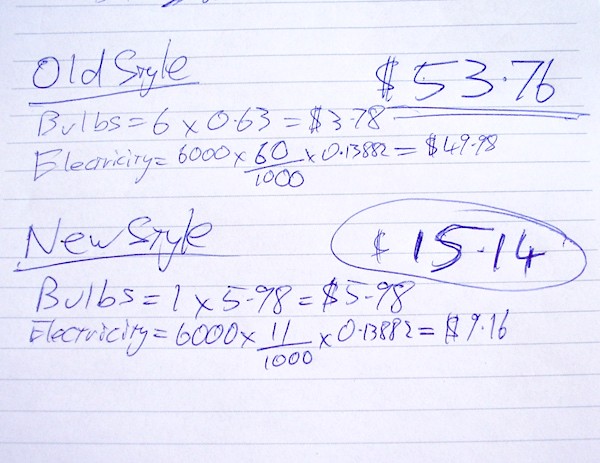
Reading on the pack that these things last 6000 hours (six times the old-style bulbs) i decided to base my calculations on that. So for both styles, i totalled the bulb cost and the electricity cost (as shown below).

As you can see, it is a significant saving, at close to $40. Of course this assumes a lifetime of 6000 hours (some brands claim 10,000). Also it assumes a constant price of electricity. Obviously, a longer lifetime / higher power price would increase the saving even further.

Buy the way, i did a calculation on how long it would take the new-style bulb to 'pay itself off'. The answer is less than 800 hours. For a bulb in common use, this is less than 5 months. After that, it's pure savings!

UPDATE: Now in 2012/13, the $40 saving is now over $70 at current electricity prices.

Monday, October 16, 2006

Seeing the Light

This week i made my first foray into the market of energy efficient bulbs. I don't know why i haven't done it before. In every other area we rush to the latest technology, and yet we still use light bulbs developed in the 19th century - which actually produce more heat than light.

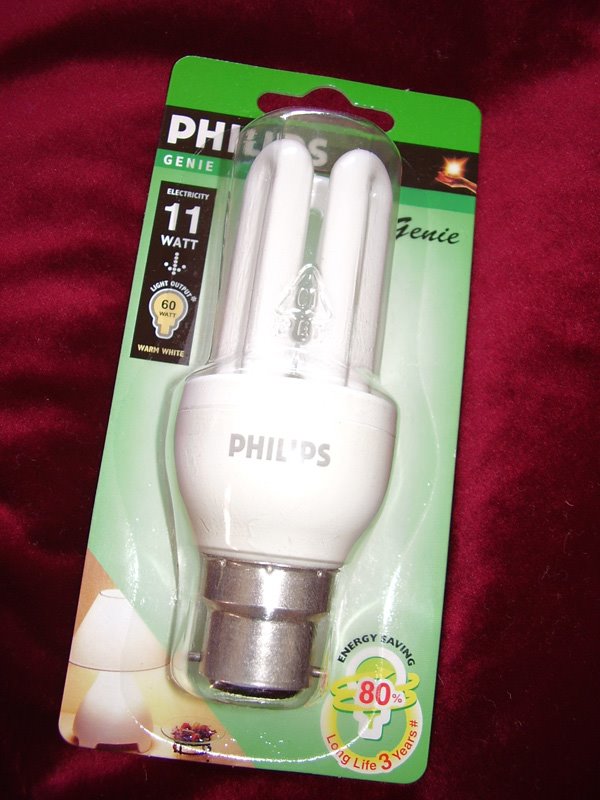
As you can see, i picked up an 11 watt bulb which produces the same amount of light as a 60 watt old-style bulb (but uses 49 less watts). So as well as conserving energy, and producing less greenhouse gases, i'm also reducing my electricity bill.