If you spend your whole year's income in 7 months, that's not good. That's what we're doing to the Earth.
Today (1 August 2018) is Earth Overshoot Day. Already this year we've used up a year's worth of natural resources.
Clearly, we can't keep going like this - unless we have a second Earth to farm, fish, pollute and dump our waste on. One Earth just can't handle all we're doing.
Australia really bad
Worse still is that countries like mine are chewing through resources even more recklessly. If everyone behaved like Australia, Earth Overshoot Day would be 31 March. That means we'd need four Earths!
How does you country compare?
Here's where that day falls for other countries. See if you can find your country. If it's not there then your country is being responsible. (Click for a larger image).
Let's not wait until it's too late
It really is like we're spending more every year than we earn. Do we have to wait until our savings have all disappeared? Hopefully we take action earlier than that - and have a long-term future on the one Earth we do have.
This is Angie - a turtle who swallowed a plastic bag. War on Waste told us she has "floating syndrome". But what is that? Why is she stuck in turtle hospital? Why can't she go back to the ocean?
Here's a brief description from Fred Nucifora of Reef HQ Aquarium:
"Floating syndrome is caused by a build up of gas in the turtle’s body, which can happen after it has ingested marine debris that blocks its gastrointestinal tract and prevents food being properly digested. The body’s unreleased gas keeps the animal afloat which not only stops it diving for food, but also makes it more vulnerable to predators like sharks or boat traffic in the area."
The options aren't great for turtles that swallow plastic. They get eaten, hit by a boat, or starve to death. That's why she'll have to stay in turtle hospital probably for the rest of her life.
In Angie's case it was a plastic bag someone used for probably a few minutes. It really is obvious that we should reduce our use of disposable plastic and increase the amount that gets recycled.
PS. The episode also showed turtles with a drinking straw lodged up their nostril. In one case it seemed to be the entire length of the straw. Ouch.
Bonus link: More on buoyancy disorders
A bottle of water a day costs a thousand dollars a year. So why do people do it?
Is it healthier?
Craig Reucassel (War on Waste) took several bottled water brands - and tap water - to the lab. No brand is really any better than tap water, and many are far worse for you.
Does it taste better?
Craig took to the streets to give people a taste test of tap-water (pretending it was bottled water) and people actually said they would switch to that "brand".
Perhaps it's all just a marketing con
The bottled water use nature-sounding words and lots of marketing. Perhaps that's why we buy it. To illustrate the point Craig made this satirical ad for Robinet Water:
Is it more convenient?
It makes it getting it easier. But without a nearby recycle bin it also makes waste easier - and that's not good. It also costs $1000 for that convenience.
Surely given the choice of having your own refillable water bottle or paying $1000 every year, the refillable bottle has to be the winner.
The War on Waste is back for a second series and this week they made a giant footprint from 1 tonne of plastic waste (in plastic bags).
Australia generates 666,000 tonnes of plastic waste a year - so this footprint is what we generate every minute (or 47 seconds to be precise).
For scale, that little thing in front of the big toe is a person.
They literally emptied a truck of these plastic bags onto the beach to visualise what 1 tonne of plastic waste looks like.
It's so much that it didn't even fit in the giant footprint - they had to pile it up.
While it took a few people quite a while to set it up, we generate this amount in under a minute. We've probably generated another footprint just while you've been reading this post.
To see it like this really is quite stunning. Surely we can get more of this recycled.
The new series of War on Waste starts tonight on ABC. Last night, panel discussion show Q&A was all about waste - how we can reduce it and how we can get more recycling happening in Australia.
Craig Reucassel (the host of War on Waste) was on the panel with people from social enterprises, a waste management expert and a representative from local government. Replay the conversation by downloading the episode or reading the transcript. You can also watch the QandA episode - and the first series of War on Waste in a special iView collection.
Stats on Waste
Here are some numbers that came from the episode:
- Last year Australia generated 64 million tonnes of waste. That's more than 2.5 tonnes per person.
- The average household wastes $60 each week on wasted food. That's 1 in 5 shopping bags.
- By 2050 there'll be more plastic in the ocean than fish.
- 95% of plastic is used only once. (I guess that includes straws, plastic bags, water bottles, coffee lids, takeaway food containers etc)
Questions from the audience included topics such as what happens to the material we recycle, how to encourage people to use tap water instead of wasteful bottled water, how to reduce food waste and the role of government in reducing waste and increasing recycling.
Tune in to ABC tonight to catch the start of Series 2 of the War on Waste.
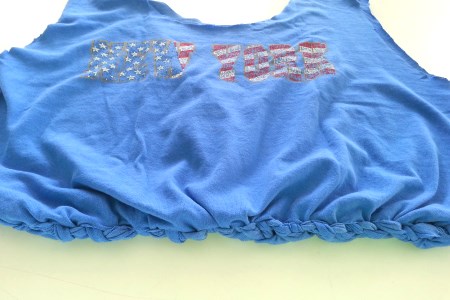
Reusable bags are great. Even better if they're unique. Here's one way to MacGyver yourself a unique reusable bag - and hold on to a fave T-shirt for a little bit longer.
Grab an old T-shirt that you like, but has been retired from public wearing. After 10 years, my New York one is a great example.
Take out the arms and the neck area. For speed, just cut along the inside of the seams. Or you can use a plate to trace a nice round curve. Up to you. You can always cut more off later, if you want to adjust the shape.
Now let's seal up the bottom. Turn it inside out. Decide how deep you want your bag to be and draw a marker line there. Cut slits up to that line. I did them about 1.5 - 2 cm apart, but it's up to you.
Tie each pair of strips together. Now you have a bunch of knots across the bottom with tiny holes in-between.
To strengthen the bag, and seal up those small holes, tie together a strand from knot 1 and a strand from knot 2. Keep going for knots 2 and 3, knots 3 and 4 etc. Now you've got a completed bag - but with a large fringe.
Cut off the excess strands and turn the bag back to the right way out. The bottom should look something like this.
Now you're ready to go. Mine turned out a little smaller than I thought - I cut the slits quite long. But this size is great for picking up a couple of things from the shops, and those other times you just need to carry a few items.
So there you go. That's how you can turn a T-shirt into a reusable bag with just a pair of scissors and a marker pen.
PS. If you like the fringe at the bottom - or you're making something for Country & Western Week - then ignore the bit about turning it inside out before cutting the slits, and just stop once you've tied all the knots.
With the quarter finals about to start, here are the greenhouse emissions (per person) of the nations competing.
Obviously I'm going to be cheering for the cleaner teams in each game. If all goes to plan Brazil will meet Sweden in the final and win. Three teams on my scoreboard are on 5 - but Brazil's 5.03 is slightly better that Sweden's 5.28 or Croatia's 5.49.
Having said that, I'd be OK with any of those three nations winning. They are all cleaner than the world average of 6.27 and far and away better than Australia's pathetic 25.
If only our emission could learnt a lesson from soccer - and take a sudden dive.
Get a re-usable cup. These last ages and even though some are made of plastic the point is that instead of tossing hundreds of disposables into landfill, you can use just one - and you can put that in the recycle bin when it gets really old.
Check out Responsible Cafes - it's a map of great coffee places that give you a discount for using a BYO cup. That could save you hundreds of dollars.
Plastic Bags
It's really quite easy to bring your own bag. The green bags are about $1 at most places and last for ages (often years). If a dollar is too much for you, my bank is giving out canvas bags for free.
I still can't believe these sell. How can you put a free thing (water) in a bottle and charge money for it? What's next? Bottled air? Just use a glass at home or a water bottle or drinking fountains if you're out and about.
Straws
This is probably the trickiest because you have to be on your game. Sometimes when you get a drink the server (without asking) will put a straw right in there as a default option.
You just have to be quick. Add it to your order. "I'd like a ____ with-no-straw". I hyphenate it to emphasise how quickly you have to say it sometimes.
If you absolutely must have a straw - maybe you're under 3 (well done on reading my blog) or maybe you just really love the slurping sound at the end of a milkshake - you can also get re-usable straws made of metal. You know, like cutlery.
Bonus tip
If you're looking for some takeaway, ask if you can put it in your own container. Many places let you do this. If your local takeaway does, then add them to the Trashless Takeaway map.
Australia has been eliminated from the Soccer World Cup, again. As I looked at the points table for Group C, I wondered how these nations compare in terms of greenhouse gases.
Here are the scores:
Not only does Australia pollute more per person than any of these nations, but the average Australian pollutes more than a French person, a Dane and a Peruvian combined.
These other nations are better at soccer and better at taking care of the planet.
And it's not just group C. It turns out that Australia is the highest polluting nation at this World Cup at 25 tonnes of greenhouse emissions per person.
Next worst is Saudi Arabia at 18 and Russia at 15. Hardly anyone even has half the greenhouse emissions of Australians.
Bank Australia is helping out Queenslanders with free calico bags, ahead of the state phasing out single-use plastic bags from this weekend.
At long last the state government is making shops be responsible and stop giving out single-use plastic bags. Shops will still be able to sell re-usable bags.
So to help people make this positive change, the bank is giving away these free calico bags. You don't even have to be a customer, though I do recommend being one - they have such great interest rates, and ethics.
The book Scienceblind is about the intuitive theories we have about the world, why they're often wrong, and why we sometimes hold on to them despite overwhelming scientific evidence.
You might imagine I headed straight for the climate change chapter. Actually, I read the introduction first. But then straight to Chapter 7.
Climate and weather
Turns out that we really do confuse weather and climate. In surveys done on hot days, people are far more likely to agree that climate change is happening.
Should one day's weather in one tiny speck of the planet really change our mind about whether the entire planet is warming year after year, decade after decade? Probably not. But it does.
What can we feel?
The thing about intuitive theories is that they are based on what we perceive. We can't perceive this month's global average temperature and compare it to similar months over the last 3 decades. We sense today's temperature - right here, right now. So that's the data we use. Not very scientific.
Another thing we perceive is that serious climate change must lead to serious behavioural changes. The more fearful we are of such changes the more we are inclined to deny that climate change exists, or deny that it is serious.
So what's the solution
Often people don't know what it is they a rejecting. A study in which people were given the following description were found to be more accepting of global warming.
Earth transforms sunlight’s visible light energy into infrared light energy, which leaves Earth slowly because it is absorbed by greenhouse gases. When people produce greenhouse gases, energy leaves Earth even more slowly - raising Earth’s temperature.
A second solution is to inform people that 97% of scientists agree that human carbon emissions are causing climate change. People tend to think this figure is around 60-70%.
Finding out that the science community is practically unanimous resulted in people being more accepting of the reality of climate change and also more willing to take action.
We use the phrase "plenty more fish in the sea" to console someone on a missed opportunity. In coming years there'll be more plastic than fish in the oceans. We may need to update the expression for our polluted world.
How did it get to this?
How did we get enough plastic in ocean to outnumber all the fish? The numbers tell the story. Globally we buy a million plastic bottles a minute. Each year we use 5 trillion plastic bags and millions of tonnes of plastic leaks into the ocean. The average Australian generates 107 kg of plastic pollution a year. Only 14% of this is recycled. The rest ends up in landfill or the ocean where it takes around 100 years to degrade.
100,000 sea creatures are killed by plastics each year. Birds that eat floating plastic, thinking it's food, have been found dead with hundred of pieces of plastic filling their stomach. It is also a problem for humans as we eat the fish that eat the tiny pieces of plastic.
What can we do?
Here in Australia we have an initiative called Plastic Free July. For one month, or for the year, you can pledge to avoid the 4 main types of disposable plastic - bags, bottles, straws and coffee cups. We can upgrade to re-usable containers, and use the sites Responsible Cafes and Trashless Takeaway to identify business that accept reusable containers. Some even give discounts.
Our consumer behaviour can help businesses be more responsible, and policy can help support these changes. Here in Queensland we're phasing out single-use plastic bags and later this year we'll start a container deposit system for plastic drink bottles - along with bottles and cans.
This can also be chance for community groups (churches, scouts, sports clubs) to collect containers as a fundraiser while also improving the environment.
Hopefully we can keep plastic out of the ocean, out of our fish and out of our bodies.
The Simply Cups website track how many cups are collected. As I write this, they've done more than 930,000 cups. From only 250 sites, that's quite amazing.
Be the best
Of course the best thing to do is to use a reusable cup (see which cafes give you a discount for that). But the next best thing is to recycle the paper cups - especially at the office where there are so many.
This Saturday Aldi (in Australia) are having an amazing sale on LED lights - which are super efficient. How efficient? Their conversion chart shows just how much less power these bulbs use to give the same light. Huge savings.
So much do these amazing pieces of technology cost? Not much.
If you're wondering how that compares to the energy the old bulbs are using, check out my Super Easy Energy Calculator.
A 60W bulb for 4 hours a night costs $24 per year in power - just for that one light. It's a great deal to slash that cost for just a few dollars. And the planet wins too.
Is there any reason not to change?
Aldi's sale starts Saturday while stocks last - so be quick.