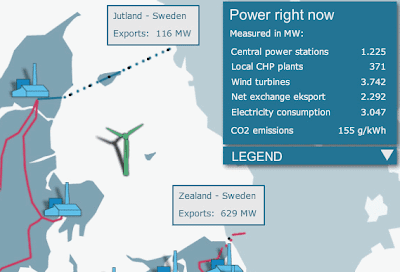
On November 3 Denmark wind power produced over 100% of the nation's energy needs. The excess wind power, along with that from other energy sources, was exported to neighbours Sweden and Norway. In the future, it could be used to produce hydrogen - helping convert transport to renewable energy also.
It's inspiring to see this level of action already happening. Many countries talk about renewable energy as an energy source of the future. But Denmark are already realising the potential - and benefiting from it.
Trivia:
1. Wind had reached 93% in October.
2. Denmark has a website of live data on its energy production.
PS: I had another look later on, and the wind production was up to 123%
Tuesday, November 26, 2013
Tuesday, November 19, 2013
Every 4 minutes
It can be sad. Climate change is a huge problem, and often it seems like we (in particular government and business) aren't doing enough (or it's happening too slowly). It can be quite depressing.
So I'm starting Good News Tuesday - at least one day per week of great or inspiring action.
This week it's the USA. On average, every 4 minutes a solar system is installed somewhere in the United States. A few have probably gone as I type these words.
I'm going to try to think about that during today. As I eat breakfast, that's another 2 systems. If I wait 4 minutes for the bus, that's another system. You get the idea. It'll be nice to remember that all the time there is positive action taking place.
That's good news.
So I'm starting Good News Tuesday - at least one day per week of great or inspiring action.
This week it's the USA. On average, every 4 minutes a solar system is installed somewhere in the United States. A few have probably gone as I type these words.
I'm going to try to think about that during today. As I eat breakfast, that's another 2 systems. If I wait 4 minutes for the bus, that's another system. You get the idea. It'll be nice to remember that all the time there is positive action taking place.
That's good news.
See more about:
good news tuesday,
renewables,
theworld
Sunday, November 10, 2013
How Climate Change hits the poor the hardest
Climate change hurts poor countries more than rich ones. This is doubly unfair, considering that these poor countries have done little to cause the problem. After writing about this for Journey magazine, I found this map of countries most likely to suffer the effects of climate change by 2025.
Red colouring indicates extreme risk from climate change. Clearly, with names like Bangladesh, Cambodia, Haiti and Ethiopia in the top 10, it's the poorest nations that are most likely to suffer - and without much financial ability to recover from disaster.
Interestingly, this analysis was done before the recent Typhoon in the Phillipines. Sadly, it seems some forecasts come true very quickly.
Red colouring indicates extreme risk from climate change. Clearly, with names like Bangladesh, Cambodia, Haiti and Ethiopia in the top 10, it's the poorest nations that are most likely to suffer - and without much financial ability to recover from disaster.
Interestingly, this analysis was done before the recent Typhoon in the Phillipines. Sadly, it seems some forecasts come true very quickly.
Monday, November 04, 2013
Energy Tales
Energy company Origin recently did a promotional campaign involving fantale-style chocolates. Given their anti-renewable comments, this parody of their chocolate wrappers amused me a little.
There is an Origin Energy petition site, asking Origin to stop undermining the Renewable Energy Target.
While being a major player in gas sector, Origin barely makes the top 20 in renewable energy.
There is an Origin Energy petition site, asking Origin to stop undermining the Renewable Energy Target.
While being a major player in gas sector, Origin barely makes the top 20 in renewable energy.
See more about:
renewables
Wednesday, October 30, 2013
Why vegetarians should go for greenpower
One of my workmates is a strict vegetarian. Despite loving the taste of meat, she won't eat it. Like many people, she would feel bad about killing an animal herself. For her, it's equally bad if someone else does the killing for her.
Perhaps the only factor enabling many people to continue eating meat is that picking up a supermarket product or some fast food is so disconnected from the slaughterhouse floor.
I wondered if the same is true for electricity from fossil fuels. The acts of watching TV, running the fridge, or having a hot shower are psychologically separated from the coal and gas burnt to make the energy.
Just as many people would never want to kill an animal, I'm sure many people don't want to pollute the air and contribute to climate change. But our actions do just that, when using 'normal' electricity.
Just as vegetarians joins the dots, and switch away from meats, I hope we all join the dots on electricity, and subscribe to greenpower.
[More posts on greenpower]
Perhaps the only factor enabling many people to continue eating meat is that picking up a supermarket product or some fast food is so disconnected from the slaughterhouse floor.
I wondered if the same is true for electricity from fossil fuels. The acts of watching TV, running the fridge, or having a hot shower are psychologically separated from the coal and gas burnt to make the energy.
Just as many people would never want to kill an animal, I'm sure many people don't want to pollute the air and contribute to climate change. But our actions do just that, when using 'normal' electricity.
Just as vegetarians joins the dots, and switch away from meats, I hope we all join the dots on electricity, and subscribe to greenpower.
[More posts on greenpower]
See more about:
action,
greenpower
Tuesday, October 29, 2013
How to defeat your own argument
A politician here in Australia has tried to downplay the link between climate change and increased bushfire. He described fires as part of living in Australia, and not a function of climate change.
On what basis? Because we've had them before. As Graham Readfern points out, that's like saying that cigarettes don't kill people, because people still died before cigarettes were invented.
But the clincher was the list of previous fires given by the same politician. The 1850s, 1939, 1968, 1983, 1994, 2001, 2009 (and now 2013). Look at the maths - in particular the gaps between those years. 80-plus, then 29, 15, 11, 7, 8, and now 4 years. This is precisely the point that climate scientists make. These events get more and more frequent as we continue to heat the planet.
It's a compelling point. Just not one that this politician intended to make.
On what basis? Because we've had them before. As Graham Readfern points out, that's like saying that cigarettes don't kill people, because people still died before cigarettes were invented.
But the clincher was the list of previous fires given by the same politician. The 1850s, 1939, 1968, 1983, 1994, 2001, 2009 (and now 2013). Look at the maths - in particular the gaps between those years. 80-plus, then 29, 15, 11, 7, 8, and now 4 years. This is precisely the point that climate scientists make. These events get more and more frequent as we continue to heat the planet.
It's a compelling point. Just not one that this politician intended to make.
See more about:
funnies,
government,
info
Thursday, October 24, 2013
What keeps scientists up at night?
We hear about what the science says on climate change. But what about the scientists? What do they think? What keeps them up at night?
This video lets us hear from scientists - unscripted and talking about what matters to them. Their work and their concern for everyone.
It's refreshing to hear the personal reflections, even the emotional difficulties of working in an area studying the potential human impacts - or feeling sorry to their kids for not leaving them a better world. Thanks Climate Institute for putting this together.
[More about the video]
This video lets us hear from scientists - unscripted and talking about what matters to them. Their work and their concern for everyone.
It's refreshing to hear the personal reflections, even the emotional difficulties of working in an area studying the potential human impacts - or feeling sorry to their kids for not leaving them a better world. Thanks Climate Institute for putting this together.
[More about the video]
See more about:
clips
Saturday, October 19, 2013
A Bully with a Brick
You probably already know about the tragic bushfires in New South Wales, that have already claimed 193 homes.
Meanwhile, Adam Bandt has drawn some controversy for linking the bushfires to global warming. Clearly he's right - scientists agree. But some say it's not the right time to say so. But I agree with the person who said that's "like watching a bully smack someone in the head with a brick and saying 'Please don't talk about the bully now, it's disrespectful to the poor person with the headache.'"
Bandt quotes Ronald Reagan "The first duty of a government is to protect its people", and encourages "action to protect Australians from this kind of disaster and tragedy in the future".
Bandt doesn't want "every summer (let alone every spring) to be worrying about whether we are going to see these kind of bushfires again". But this is what scientists, and firefighters, have been warning Australia to expect from global warming. If we don't get global warming under control, the forecasts are for fires like 'Black Saturday' to happen about once every two years in Victoria. And that doesn't include the rest of the country.
Meanwhile, the government this week announced legislation to remove Australia's main policy to reduce greenhouse emissions - the carbon price. Now that's bad timing. While the government talk about the financial savings of doing that, they don't talk much about the other costs of climate change. Like losing your home in a bushfire.
[Link: Article by Adam Bandt]
Meanwhile, Adam Bandt has drawn some controversy for linking the bushfires to global warming. Clearly he's right - scientists agree. But some say it's not the right time to say so. But I agree with the person who said that's "like watching a bully smack someone in the head with a brick and saying 'Please don't talk about the bully now, it's disrespectful to the poor person with the headache.'"
Bandt quotes Ronald Reagan "The first duty of a government is to protect its people", and encourages "action to protect Australians from this kind of disaster and tragedy in the future".
Bandt doesn't want "every summer (let alone every spring) to be worrying about whether we are going to see these kind of bushfires again". But this is what scientists, and firefighters, have been warning Australia to expect from global warming. If we don't get global warming under control, the forecasts are for fires like 'Black Saturday' to happen about once every two years in Victoria. And that doesn't include the rest of the country.
Meanwhile, the government this week announced legislation to remove Australia's main policy to reduce greenhouse emissions - the carbon price. Now that's bad timing. While the government talk about the financial savings of doing that, they don't talk much about the other costs of climate change. Like losing your home in a bushfire.
[Link: Article by Adam Bandt]
See more about:
clips,
government
Wednesday, October 09, 2013
World Solar Challenge 2013
This solar car Darwin-to-Adelaide race is held every 2 years in Australia. What excites me is that rules get tougher each time, as the cars improve. They are looking less like science experiments, and more like everyday, usable cars.
For those interested in the race, the Nuon team of the Netherlands looks like the favourite to win it. The live race map, photos and more are at worldsolarchallenge.org.
Related post: Running on Sunshine
For those interested in the race, the Nuon team of the Netherlands looks like the favourite to win it. The live race map, photos and more are at worldsolarchallenge.org.
Related post: Running on Sunshine
See more about:
renewables,
transport
Thursday, October 03, 2013
What does it mean for Australia?
The latest climate change report is out, as I wrote on Monday. But what does it mean for Australia?
The hottest days will be up to 6 degrees hotter (remember Sydney was already 46°C last summer). Increased sea level rise could affect our coastal cities, and increased flood and drought will be bad news for agricultural areas.
During the release of the report, some prominent scientists had some comments about the effects for Australia:
The hottest days will be up to 6 degrees hotter (remember Sydney was already 46°C last summer). Increased sea level rise could affect our coastal cities, and increased flood and drought will be bad news for agricultural areas.
During the release of the report, some prominent scientists had some comments about the effects for Australia:
"I am concerned about the unabated increase in upper ocean heat content reported by the IPCC. This is of particular relevance for eastern Australia where heat stored in the upper ocean has contributed to the major extreme rainfall and Queensland flood events during the summers of 2011 and 2012.
With a large population living close to the coast in Australia it is a real worry that sea level estimates have been revised upwards in the current IPCC Report – and their estimate is on the conservative side. This means we need a major rethink of how we manage, use, and develop our coastal communities and cities."
Dr Helen McGregor, University of Wollongong
"For Australia, this ratio (of more warm records, fewer cold ones) has been noted for decades."
Dr Julie Arblaster, Bureau of Meteorology (BoM)
"This is really going to be crucial to Australia's future. We're looking at impacts in Australia that are going to be at least as bad as other places because Australia sits at a range of latitudes that are expected to dry out as a result of a warmer climate. We tend to live on the coasts and sea levels are going to keep rising, and it's also a country that experiences extremes of heat."
Professor Steven Sherwood
See more about:
info
Wednesday, October 02, 2013
Yes - The Hottest September Ever
It's official. September 2013 was Australia's hottest September on record (breaking the 2005 record). That also means the last 12 months is the hottest 12-month period on record (breaking the record from earlier this year).
On a 1-10 scale orange areas indicate a 10, and dark orange indicates hottest on record. Obviously, a number of states also set records.
Combined with our hottest summer ever (particularly in January) and a very warm winter, it looks like 2013 could also be Australia's hottest calendar year. Surely it's time to do something about this.
PS. It turns out that my colleague and I were both right.
On a 1-10 scale orange areas indicate a 10, and dark orange indicates hottest on record. Obviously, a number of states also set records.
Combined with our hottest summer ever (particularly in January) and a very warm winter, it looks like 2013 could also be Australia's hottest calendar year. Surely it's time to do something about this.
PS. It turns out that my colleague and I were both right.
Tuesday, October 01, 2013
Time after time
I had a bit of a deja vu moment while writing yesterday's piece. This cartoon by Kudelka might help explain why.
Hopefully, for our own sake, we really start listening soon.
See more about:
funnies
Monday, September 30, 2013
Even more certain about climate change
One of the best summaries of the IPCC's latest climate report is 15 Things You Should Know. In short, it mentions that:
1. Climate change is happening and we're doing it. Scientists are 95-100% certain - which puts it about level with smoking causing cancer.
2. There has been no slow down in warming. The last 30 years were the warmest 30 years. The rate of warming is 10 times faster than any time in 65 million years.
3. We need to leave 90% of fossil fuels untouched, to have a reasonable chance of avoiding catastrophe.
Perhaps it was summed up best by the headline "Jury In: Climate Change Real, Caused by Us, and a Threat We Must Deal With".
Interesting trivia about the report includes that more than 2,000 scientists worked on it. 9,200 studies were analysed, which were based on over 2 million gigabytes of data. (That's 20,000 times the size of my laptop computer!).
1. Climate change is happening and we're doing it. Scientists are 95-100% certain - which puts it about level with smoking causing cancer.
2. There has been no slow down in warming. The last 30 years were the warmest 30 years. The rate of warming is 10 times faster than any time in 65 million years.
3. We need to leave 90% of fossil fuels untouched, to have a reasonable chance of avoiding catastrophe.
Perhaps it was summed up best by the headline "Jury In: Climate Change Real, Caused by Us, and a Threat We Must Deal With".
Interesting trivia about the report includes that more than 2,000 scientists worked on it. 9,200 studies were analysed, which were based on over 2 million gigabytes of data. (That's 20,000 times the size of my laptop computer!).
Friday, September 27, 2013
Hottest September Ever?
A work colleague heard a news report that this could be our hottest September ever (and she sounded quite stunned by this news). You might guess that I explained how it wouldn't exactly be the world's biggest surprise.
This map is the last 12 months in Australia. On a hot scale of 1 to 10, almost all of Australia has been a 10 for the past year. The dark orange is where the past 12 months has been the hottest on record. About one-third of the country has never been this hot.
We've also just had the 2nd warmest winter ever. So yes, my office buddy, I wouldn't be surprised if this also turns out to be the hottest September we've ever had. And I wouldn't be surprised if these kind of records keep tumbling.
Link: BOM Climate Summaries
This map is the last 12 months in Australia. On a hot scale of 1 to 10, almost all of Australia has been a 10 for the past year. The dark orange is where the past 12 months has been the hottest on record. About one-third of the country has never been this hot.
We've also just had the 2nd warmest winter ever. So yes, my office buddy, I wouldn't be surprised if this also turns out to be the hottest September we've ever had. And I wouldn't be surprised if these kind of records keep tumbling.
Link: BOM Climate Summaries
See more about:
info
Wednesday, September 25, 2013
Double Exposure - Spot the Difference
Climate change destroys reefs. We've heard it plenty of times, but now we can see it, thanks to photography project Double Exposure.
This picture is of the Rhone Reef in the British Virgin Islands (in 2004 and in 2011). The difference is shocking.
For more photos, including ones worse than this one, check out the Double Exposure website, and see how climate change is already altering our world.
This picture is of the Rhone Reef in the British Virgin Islands (in 2004 and in 2011). The difference is shocking.
For more photos, including ones worse than this one, check out the Double Exposure website, and see how climate change is already altering our world.
See more about:
info
Subscribe to:
Posts (Atom)


