Bank Australia is helping out Queenslanders with free calico bags, ahead of the state phasing out single-use plastic bags from this weekend.
At long last the state government is making shops be responsible and stop giving out single-use plastic bags. Shops will still be able to sell re-usable bags.
Bank Australia is an ethical bank that avoids lending to coal gas and oil companies - and even gives a percentage of its profits to community groups doing good things for our environment.
So to help people make this positive change, the bank is giving away these free calico bags. You don't even have to be a customer, though I do recommend being one - they have such great interest rates, and ethics.
Tuesday, June 26, 2018
Wednesday, June 13, 2018
Are we Scienceblind?
The book Scienceblind is about the intuitive theories we have about the world, why they're often wrong, and why we sometimes hold on to them despite overwhelming scientific evidence.
You might imagine I headed straight for the climate change chapter. Actually, I read the introduction first. But then straight to Chapter 7.
Should one day's weather in one tiny speck of the planet really change our mind about whether the entire planet is warming year after year, decade after decade? Probably not. But it does.
Another thing we perceive is that serious climate change must lead to serious behavioural changes. The more fearful we are of such changes the more we are inclined to deny that climate change exists, or deny that it is serious.
A second solution is to inform people that 97% of scientists agree that human carbon emissions are causing climate change. People tend to think this figure is around 60-70%.
Finding out that the science community is practically unanimous resulted in people being more accepting of the reality of climate change and also more willing to take action.
You might imagine I headed straight for the climate change chapter. Actually, I read the introduction first. But then straight to Chapter 7.
Climate and weather
Turns out that we really do confuse weather and climate. In surveys done on hot days, people are far more likely to agree that climate change is happening.Should one day's weather in one tiny speck of the planet really change our mind about whether the entire planet is warming year after year, decade after decade? Probably not. But it does.
What can we feel?
The thing about intuitive theories is that they are based on what we perceive. We can't perceive this month's global average temperature and compare it to similar months over the last 3 decades. We sense today's temperature - right here, right now. So that's the data we use. Not very scientific.Another thing we perceive is that serious climate change must lead to serious behavioural changes. The more fearful we are of such changes the more we are inclined to deny that climate change exists, or deny that it is serious.
So what's the solution
Often people don't know what it is they a rejecting. A study in which people were given the following description were found to be more accepting of global warming.Earth transforms sunlight’s visible light energy into infrared light energy, which leaves Earth slowly because it is absorbed by greenhouse gases. When people produce greenhouse gases, energy leaves Earth even more slowly - raising Earth’s temperature.
A second solution is to inform people that 97% of scientists agree that human carbon emissions are causing climate change. People tend to think this figure is around 60-70%.
Finding out that the science community is practically unanimous resulted in people being more accepting of the reality of climate change and also more willing to take action.
See more about:
books and dvds,
info
Thursday, May 31, 2018
Plenty more trash in the sea
We use the phrase "plenty more fish in the sea" to console someone on a missed opportunity. In coming years there'll be more plastic than fish in the oceans. We may need to update the expression for our polluted world.
In 2016, a yoghurt container from the '76 Olympics washed up on a beach in France. Closer to home, Gold Coast man Jim Hinds picks rubbish out of the waterways. He averages about 10,000 items per month.
So this year's World Environment Day theme is Beat Plastic Pollution.
Our consumer behaviour can help businesses be more responsible, and policy can help support these changes. Here in Queensland we're phasing out single-use plastic bags and later this year we'll start a container deposit system for plastic drink bottles - along with bottles and cans.
This can also be chance for community groups (churches, scouts, sports clubs) to collect containers as a fundraiser while also improving the environment.
Hopefully we can keep plastic out of the ocean, out of our fish and out of our bodies.
How did it get to this?
How did we get enough plastic in ocean to outnumber all the fish? The numbers tell the story. Globally we buy a million plastic bottles a minute. Each year we use 5 trillion plastic bags and millions of tonnes of plastic leaks into the ocean. The average Australian generates 107 kg of plastic pollution a year. Only 14% of this is recycled. The rest ends up in landfill or the ocean where it takes around 100 years to degrade.In 2016, a yoghurt container from the '76 Olympics washed up on a beach in France. Closer to home, Gold Coast man Jim Hinds picks rubbish out of the waterways. He averages about 10,000 items per month.
So this year's World Environment Day theme is Beat Plastic Pollution.
Why does this matter?
100,000 sea creatures are killed by plastics each year. Birds that eat floating plastic, thinking it's food, have been found dead with hundred of pieces of plastic filling their stomach. It is also a problem for humans as we eat the fish that eat the tiny pieces of plastic.What can we do?
Here in Australia we have an initiative called Plastic Free July. For one month, or for the year, you can pledge to avoid the 4 main types of disposable plastic - bags, bottles, straws and coffee cups. We can upgrade to re-usable containers, and use the sites Responsible Cafes and Trashless Takeaway to identify business that accept reusable containers. Some even give discounts.Our consumer behaviour can help businesses be more responsible, and policy can help support these changes. Here in Queensland we're phasing out single-use plastic bags and later this year we'll start a container deposit system for plastic drink bottles - along with bottles and cans.
This can also be chance for community groups (churches, scouts, sports clubs) to collect containers as a fundraiser while also improving the environment.
Hopefully we can keep plastic out of the ocean, out of our fish and out of our bodies.
Wednesday, May 30, 2018
Trashless Takeaway
We enjoy great food, but it's disappointing when it comes in a white foam container - or other non-recyclable plastic that will end up in the bin.
Australians generate 107 kg of plastic waste per person - and only 14% gets recycled. The rest goes to landfill or ends up in the ocean.
Trashless Takeaway shows you the shops that accept reusable containers for takeaway food. You may even get a discount.
Ways to help trashless take off:
Apart from saving the planet, this can be healthier, cheaper and yummier. Business can also save money and get more exposure.
Find out more about The Plastic Problem - and the solution.
PS. For coffee shops, there's a similar site called Responsible Cafes.
Australians generate 107 kg of plastic waste per person - and only 14% gets recycled. The rest goes to landfill or ends up in the ocean.
Trashless Takeaway shows you the shops that accept reusable containers for takeaway food. You may even get a discount.
Ways to help trashless take off:
- Support the places that are help reduce plastic pollution
- Add #trashlesstakeaway to your photo of your trashless meal
- Ask your favourite place if they accept reusable containers
- Add them to the map if they they do
Apart from saving the planet, this can be healthier, cheaper and yummier. Business can also save money and get more exposure.
Find out more about The Plastic Problem - and the solution.
PS. For coffee shops, there's a similar site called Responsible Cafes.
See more about:
action,
consumption,
tips
Tuesday, May 22, 2018
Cup Rescue now underway
Paper coffee cups. How do we recycle them? 7-Eleven have launched Cup Rescue and aim to recycle 70 million cups each year.
The Simply Cups website track how many cups are collected. As I write this, they've done more than 930,000 cups. From only 250 sites, that's quite amazing.
What to do
At selected 7-Eleven stores you can return your paper coffee cups, the lids, and slurpee cups into these handy tubes to be recycled by Simply Cups.Where is it?
Enter your postcode to see if your local store participates. If it doesn't have one, ask 7-Eleven to put one there.Start your own
You can also contact Simply Cups and register to have a coffee cup collection at your workplace, school or event to save cups from landfill.The Simply Cups website track how many cups are collected. As I write this, they've done more than 930,000 cups. From only 250 sites, that's quite amazing.
Be the best
Of course the best thing to do is to use a reusable cup (see which cafes give you a discount for that). But the next best thing is to recycle the paper cups - especially at the office where there are so many.Thursday, May 10, 2018
Sale this weekend - LED bulbs
This Saturday Aldi (in Australia) are having an amazing sale on LED lights - which are super efficient. How efficient? Their conversion chart shows just how much less power these bulbs use to give the same light. Huge savings.
So much do these amazing pieces of technology cost? Not much.
LED bulbs are $2.99 (to replace a standard bulb)
Dimmable LED bulbs are a bit more - $6.99.
LEDs downlights to replace halogens are just $4.99.
If you're wondering how that compares to the energy the old bulbs are using, check out my Super Easy Energy Calculator.
A 60W bulb for 4 hours a night costs $24 per year in power - just for that one light. It's a great deal to slash that cost for just a few dollars. And the planet wins too.
Is there any reason not to change?
Aldi's sale starts Saturday while stocks last - so be quick.
So much do these amazing pieces of technology cost? Not much.
LED bulbs are $2.99 (to replace a standard bulb)
Dimmable LED bulbs are a bit more - $6.99.
LEDs downlights to replace halogens are just $4.99.
If you're wondering how that compares to the energy the old bulbs are using, check out my Super Easy Energy Calculator.
A 60W bulb for 4 hours a night costs $24 per year in power - just for that one light. It's a great deal to slash that cost for just a few dollars. And the planet wins too.
Is there any reason not to change?
Aldi's sale starts Saturday while stocks last - so be quick.
Tuesday, April 24, 2018
Super Easy Energy Cost Calculator
How much energy does a light bulb use? Is it worth replacing? Those kind of answers can be found with this easy guide.
Find the light bulb wattage on the left hand side. Across the top find the hours per day it is used. Where that row and column meet is the cost of powering that light bulb for one year.
An old 75 Watt bulb running 5 hours a night costs $37 a year. Definitely worth changing to a more efficient option.
It also works for other items - if you know their power usage. A stereo that uses 10 Watts in standby mode all day will cost $24 a year even without playing any music (might be worth turning off at the wall). A laptop computer that uses 20 Watts and is used for 4 hours per day will cost just $8 to run.
For this calculator I've assumed 27 cents per unit of electricity. If your price is different then the estimates may vary.
Also, if the exact wattage isn't in the table, use one that is close to it as an estimate. Or if you've got a calculator you can do the exact calculations yourself. Here's the formula:
Cost = Watts x hours/day x 0.365 x price($/kWh)
Find the light bulb wattage on the left hand side. Across the top find the hours per day it is used. Where that row and column meet is the cost of powering that light bulb for one year.
An old 75 Watt bulb running 5 hours a night costs $37 a year. Definitely worth changing to a more efficient option.
It also works for other items - if you know their power usage. A stereo that uses 10 Watts in standby mode all day will cost $24 a year even without playing any music (might be worth turning off at the wall). A laptop computer that uses 20 Watts and is used for 4 hours per day will cost just $8 to run.
For this calculator I've assumed 27 cents per unit of electricity. If your price is different then the estimates may vary.
Also, if the exact wattage isn't in the table, use one that is close to it as an estimate. Or if you've got a calculator you can do the exact calculations yourself. Here's the formula:
Friday, April 20, 2018
Quiz: Are you a climate champ?
Take this quiz to find out how you score on your climate change knowledge.
It's been all over the news, but how much information has sunk in?
I aced it with 10 from 10 - but it is multiple choice so that makes it a bit easier.
It's been all over the news, but how much information has sunk in?
I aced it with 10 from 10 - but it is multiple choice so that makes it a bit easier.
See more about:
info
Monday, April 16, 2018
Should I get solar?
It's a question that many people have asked. Australian consumer affairs TV show The Checkout took a look at at practically every solar question people ask.
Quirkiness is the trademark of the show, but the information is good.
Here's the link to the solar calculator they mention.
In case you missed it, here is the information on payback periods.
Quirkiness is the trademark of the show, but the information is good.
Here's the link to the solar calculator they mention.
In case you missed it, here is the information on payback periods.
See more about:
action,
clips,
info,
renewables
Wednesday, March 28, 2018
How to save 88% on power
Check out the blue and red boxes on this energy sticker (for our washing machine).
Those numbers (55 and 464) represent the energy needed for cold and hot washes. Quick maths shows the blue number is 88% less than the red number.
To put that another way, the hot wash uses more than 8 times as much energy. Surely this is a no-brainer.
For cold washes that's a yearly total of $14.85 in electricity. If we used hot water, that number would surge to $125.28. Woah, that's a big difference.
The cold wash button is a real saver.
Those numbers (55 and 464) represent the energy needed for cold and hot washes. Quick maths shows the blue number is 88% less than the red number.
To put that another way, the hot wash uses more than 8 times as much energy. Surely this is a no-brainer.
For cold washes that's a yearly total of $14.85 in electricity. If we used hot water, that number would surge to $125.28. Woah, that's a big difference.
The cold wash button is a real saver.
Wednesday, March 21, 2018
Choosing the right lights
Often there's a mental barrier to getting energy-saving lights. They cost money.
The Checkout did the maths for a light that's on 5 hours per night at a price of 30 cents/kWh.
A six dollar bulb can save you around $20 every year! That's an amazing return on your money.
Plus they also last longer. So in the long run you save even more by not having to replace them as often.
The video also mentions the Light Bulb Saver app. It's handy for calculating the saving for your particular situation and is available on Google Play and iTunes.
Is it worth it?
Yes. Even if you're renting. For your main lights, most upgrades make their money back in less than a year.The Checkout did the maths for a light that's on 5 hours per night at a price of 30 cents/kWh.
A six dollar bulb can save you around $20 every year! That's an amazing return on your money.
Plus they also last longer. So in the long run you save even more by not having to replace them as often.
The video also mentions the Light Bulb Saver app. It's handy for calculating the saving for your particular situation and is available on Google Play and iTunes.
Wednesday, March 14, 2018
5% off power thanks to renewables
Powershop, the energy retailer that loves renewable energy, has just announced a 5% price-cut "all thanks to renewable energy".
CEO Ed McManus says it's because they've managed to get really good price deals with new wind and solar farms.
See the video for more information or read more details of the power stations.
At the moment this price-cut is for Victorian customers only, with NSW and Queensland customers to expect a lower price around mid-year.
CEO Ed McManus says it's because they've managed to get really good price deals with new wind and solar farms.
“The price that we get the energy from these new wind and solar farms is cheaper than the energy we can get from the normal wholesale market day to day.”
See the video for more information or read more details of the power stations.
Today a price drop for all our customers in VIC thanks to our investments in renewable energy. NSW/QLD stay tuned. Got Qs, go here: https://t.co/H75pUXAGx4🌱💫
— Powershop Australia (@PowershopAus) February 28, 2018
At the moment this price-cut is for Victorian customers only, with NSW and Queensland customers to expect a lower price around mid-year.
See more about:
renewables
Monday, March 12, 2018
An unprecedented 5 years
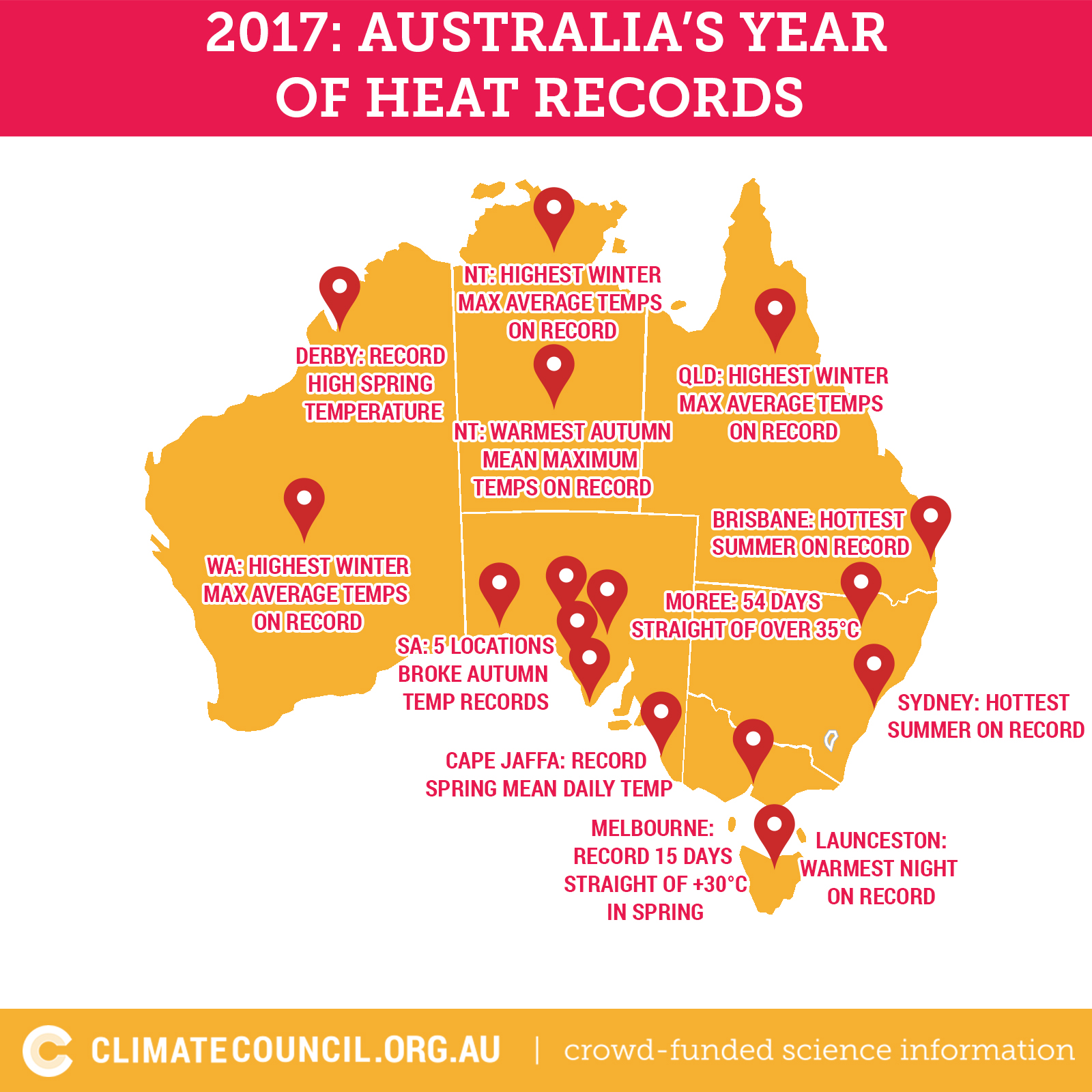
The last 5 years (2013-2017) is officially the hottest period on record. More details are in the Climate Council's report "2017: Record-breaking Year for Heat and Extreme Weather".
This heat graph really tells the story.
There's a bit of variation from year to year. Often are El Nino years are a bit hotter and La Nina years not so much. This next graph colours the El Nino and La Nina years differently. We can see that even La Nina years (blue) are getting hotter, as are the El Nino years and neutral years. Which ever way we look at it we are entering uncharted territory.
The report also found that
This heat graph really tells the story.
There's a bit of variation from year to year. Often are El Nino years are a bit hotter and La Nina years not so much. This next graph colours the El Nino and La Nina years differently. We can see that even La Nina years (blue) are getting hotter, as are the El Nino years and neutral years. Which ever way we look at it we are entering uncharted territory.
The report also found that
- 2017 was the third hottest year ever recorded, and the hottest year in which temperatures have not been boosted by an El Niño event.
- The world’s 10 hottest years on record have all occurred since 1998 and 17 of the 18 hottest years on record have occurred this century.
- 2017 was Australia’s third hottest year on record.
- Seven of the ten hottest years on record in Australia have happened since 2005. Five of the seven have occurred the past five years.
- 2017 broke records for hot, dry conditions with more than 260 heat and low rainfall records broken throughout winter.
- The increasing global heat, driven primarily by the burning of fossil fuels, exacerbated extreme weather events around the globe and in Australia in 2017.
Thursday, January 18, 2018
How hot will it get in my lifetime?
Want something scary? Type your year of birth (or your child's) into this website.
It's summer in Australia right now and that means heatwave forecasts on a regular basis. Sometimes it's scary to think how much hotter it will get.
Sydney hit 47.3°C (117 F) recently. That's not the kind of temperature you want to add more degrees to.
It's summer in Australia right now and that means heatwave forecasts on a regular basis. Sometimes it's scary to think how much hotter it will get.
Sydney hit 47.3°C (117 F) recently. That's not the kind of temperature you want to add more degrees to.
Tuesday, October 03, 2017
The day I got into a racecar
This is the TeamArrow solar racecar. TeamArrow are based here in Brisbane and compete in the World Solar Challenge (2017 Challenge starts 8 October). They finished 8th in 2015 and I got to climb inside their racecar.
The car is 220 kg, cruises at around 85 kph and has a top speed of 126 kph. Surprisingly, it does all this on the same amount of power as your average toaster. Phenomenal.
Part of the reason is aerodynamics. After all, this is a racecar. Even the wheels are covered in an aerodynamic fin and the height of the car is quite low. I've had to squat down to be at the same height as a driver.
Of course I couldn't let the day go by without taking the opportunity to sit inside an actual racecar. After this photo was taken they put the aerodynamic lid on (you can see it in the first photo). It wasn't exactly spacious in there, but that's part of racing I guess.
On the day they were talking about their new car for this year's World Solar Challenge.
It will be in the "Cruiser" category, meaning it's a 2-person car and looks less like a racecar and more like something you might drive on the streets.
They hope to have them available for sale to the public soon after the race.
The car is 220 kg, cruises at around 85 kph and has a top speed of 126 kph. Surprisingly, it does all this on the same amount of power as your average toaster. Phenomenal.
Part of the reason is aerodynamics. After all, this is a racecar. Even the wheels are covered in an aerodynamic fin and the height of the car is quite low. I've had to squat down to be at the same height as a driver.
Of course I couldn't let the day go by without taking the opportunity to sit inside an actual racecar. After this photo was taken they put the aerodynamic lid on (you can see it in the first photo). It wasn't exactly spacious in there, but that's part of racing I guess.
On the day they were talking about their new car for this year's World Solar Challenge.
It will be in the "Cruiser" category, meaning it's a 2-person car and looks less like a racecar and more like something you might drive on the streets.
They hope to have them available for sale to the public soon after the race.
See more about:
renewables,
transport
Subscribe to:
Posts (Atom)